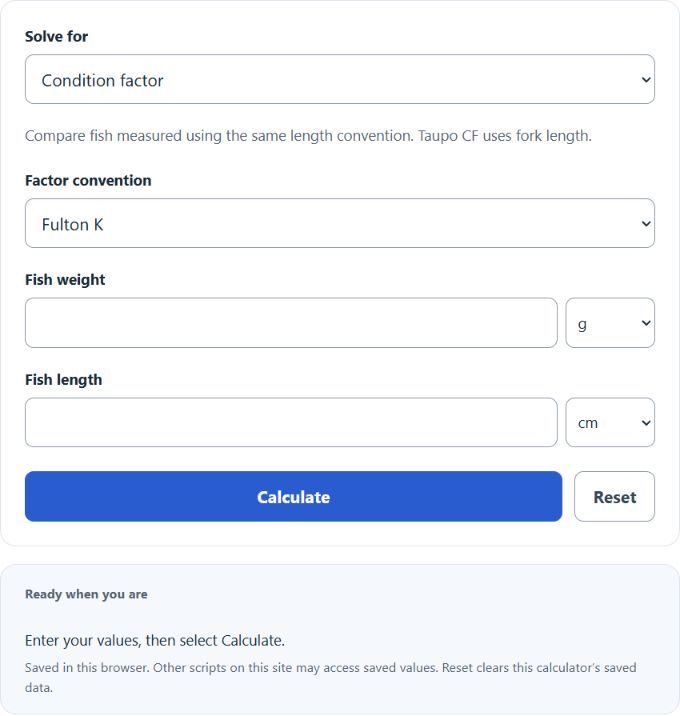
Select condition factor, fish weight, fish length, or the Fulton weight table. Use consistent length measurements; Taupo CF uses fork length.
Condition Factor Formula
The condition factor compares a fish’s weight to its length. A higher value generally means the fish is heavier for its length, while a lower value means it is slimmer.
Fulton condition factor:
Fulton weight from condition factor:
Fulton length from condition factor:
Taupo condition factor:
Taupo weight from condition factor:
Taupo length from condition factor:
- K = Fulton condition factor
- CF = Taupo condition factor
- W = fish weight. For both metric formulas shown here, weight is in grams.
- L = fish length. Length is in centimeters; Taupo CF uses fork length.
Select the value to solve and enter the two required quantities. Both conventions convert inputs to grams and centimeters. Taupo CF = 3612.8 × W(g) / fork L(cm)³, approximately 100,000 × W(lb) / fork L(in)³. The weight table estimates weight from an editable Fulton K and length.
Condition Factor Interpretation
The following historical example bands are illustrative labels, not validated health thresholds. Condition factors vary with species, size, season, sex and reproductive state. The calculator reports numerical indexes without assigning these generic grades.
| Fulton K range | Illustrative label | Illustrative description |
|---|---|---|
| Less than 0.80 | Very slim | Light for its length |
| 0.80 to 0.94 | Slim | Below typical body depth or weight |
| 0.95 to 1.10 | Normal | Typical weight for its length |
| 1.11 to 1.30 | Fat | Heavier than average for its length |
| Greater than 1.30 | Very fat | Very heavy for its length |
Common Unit Conversions for Fish Condition Factor
| Measurement | Conversion used |
|---|---|
| 1 kilogram | 1,000 grams |
| 1 pound | 453.59237 grams |
| 1 ounce | 28.349523125 grams |
| 1 meter | 100 centimeters |
| 1 inch | 2.54 centimeters |
| 1 foot | 30.48 centimeters |
Example Condition Factor Calculations
Example 1: Calculate Fulton K
You catch a fish that weighs 800 g and is 40 cm long.
The Fulton condition factor is 1.25. This alone does not establish the fish’s health or a universal condition grade.
Example 2: Estimate weight from Fulton K
You have a 50 cm fish and want to estimate its weight using K = 1.0.
The estimated weight is 1,250 g, or 1.25 kg.
Condition Factor Calculator FAQ
What is a good condition factor for fish?
A Fulton K near 1.0 is often treated as a normal reference value, but it is not a universal standard for every species. Some species naturally have deeper bodies and higher K values, while long, slender species may have lower values even when healthy. For the best comparison, use condition factor to compare fish of the same species, from the same area, measured in the same way.
What length should you use for condition factor?
Use the same type of length measurement each time you compare fish. Total length, fork length, and standard length can produce different condition factors. Use fork length for Taupo CF. Fulton comparisons must use the same specified length type; mixing length types makes results hard to compare.
Why does condition factor use length cubed?
Fish weight generally changes with body volume, and volume scales with the cube of length. Cubing the length helps compare body condition across fish of different sizes by relating weight to a length-based volume estimate.