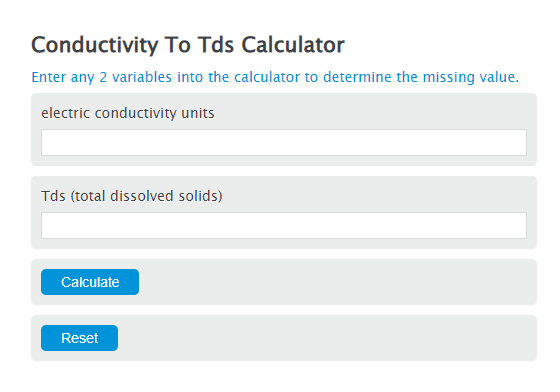
Calculate TDS from electrical conductivity or estimate conductivity from TDS using EC × 0.64 with μS/cm, mS/cm, S/m, ppm, and mg/L.
- All Unit Converters
- Conductivity to Resistivity Calculator
- Cooling Tower Cycles of Concentration Calculator
Conductivity To TDS Formula
Variables:
- TDS is the estimated total dissolved solids, usually reported as ppm (equal to mg/L for dilute aqueous solutions).
- EC is the electrical conductivity (temperature-compensated to 25 °C), expressed in μS/cm.
- k is the conversion factor, which depends on dissolved ion composition and meter calibration standard (commonly 0.5 to 0.7).
To estimate TDS from conductivity, multiply EC by an appropriate conversion factor k. Many handheld meters use a factor around 0.5 to 0.7; this calculator uses k = 0.64 (a common NaCl-type factor).
Calibration Standards and k Factors
TDS meters are calibrated to one of three standard solutions, each producing a different k factor. Using the wrong standard for your application introduces systematic error. Most consumer meters default to the NaCl scale.
| Standard | Composition | k Factor | Best For |
|---|---|---|---|
| NaCl | Sodium chloride | 0.47 to 0.50 | Seawater, brackish water, brine |
| KCl | Potassium chloride | 0.50 to 0.57 | Laboratory instruments (international reference) |
| 442 | 40% Na₂SO₄ + 40% NaHCO₃ + 20% NaCl | 0.65 to 0.85 | Natural freshwater: rivers, wells, lakes |
| * The same water sample measured on meters with different calibration standards will show different TDS readings. The 442 standard most closely represents natural freshwater chemistry. KCl is the international conductivity calibration reference. | |||
| Conductivity (μS/cm) | Estimated TDS (ppm) |
|---|---|
| 10 | 6.4 |
| 25 | 16.0 |
| 50 | 32.0 |
| 75 | 48.0 |
| 100 | 64.0 |
| 150 | 96.0 |
| 200 | 128.0 |
| 250 | 160.0 |
| 300 | 192.0 |
| 400 | 256.0 |
| 500 | 320.0 |
| 600 | 384.0 |
| 750 | 480.0 |
| 1000 | 640.0 |
| 1500 | 960.0 |
| 2000 | 1280.0 |
| 2500 | 1600.0 |
| 3000 | 1920.0 |
| 5000 | 3200.0 |
| 10000 | 6400.0 |
| * Uses k = 0.64. For dilute solutions, ppm and mg/L are interchangeable. Rule of thumb: 1 μS/cm ≈ 0.64 ppm. | |
EC and TDS by Water Type
The table below gives typical EC and estimated TDS ranges for common water types, referenced to 25 °C. These ranges are useful for sanity-checking meter readings or setting targets for specific applications.
| Water Type | EC (μS/cm) | TDS (ppm) | Notes |
|---|---|---|---|
| Ultra-pure / deionized | <1 | <0.5 | Semiconductor and pharmaceutical production |
| RO permeate | <50 | <25 | Reverse osmosis system output |
| Rainwater (clean) | 2 to 50 | 1 to 30 | Increases with atmospheric pollution |
| Drinking water (WHO excellent) | <500 | <300 | WHO top rating; optimal taste range: 50 to 150 ppm |
| Tap water (typical) | 500 to 800 | 300 to 500 | EPA secondary standard max: 500 ppm |
| Bottled spring water | 200 to 800 | 100 to 500 | Varies widely by source geology |
| Freshwater river | 30 to 2,000 | 20 to 1,200 | Depends on watershed geology and land use |
| Aquarium (freshwater community) | 100 to 300 | 60 to 200 | Soft-water species (discus, tetras): below 100 μS/cm |
| Aquarium (African cichlid) | 500 to 1,500 | 300 to 1,000 | Targets rift lake chemistry (Malawi, Tanganyika) |
| Hydroponics nutrient solution | 1,500 to 3,500 | 1,000 to 2,200 | Varies by crop type and growth stage |
| Brackish water | 1,000 to 50,000 | 650 to 32,000 | Estuarine transition zone |
| Seawater | ~53,000 | ~35,000 | Standard salinity ~35 g/kg; k factor does not apply |
| Industrial boiler feedwater | <10 | <6 | Strict purity limits to prevent scale and corrosion |
| * Seawater TDS reflects actual dissolved salt mass and is not derived from the 0.64 factor. All other TDS values are estimates using k = 0.64. | |||
WHO Drinking Water TDS Classification
The World Health Organization rates drinking water by TDS level. The U.S. EPA secondary standard sets a recommended maximum of 500 ppm. Water below 50 ppm often tastes flat because it lacks mineral character; the 50 to 150 ppm range is generally considered optimal for flavor.
| TDS (ppm) | EC (μS/cm) | WHO Rating |
|---|---|---|
| Below 300 | Below 469 | Excellent |
| 300 to 600 | 469 to 938 | Good |
| 600 to 900 | 938 to 1,406 | Fair |
| 900 to 1,200 | 1,406 to 1,875 | Poor |
| Above 1,200 | Above 1,875 | Unacceptable |
| * EC estimates use reverse conversion: EC = TDS / 0.64. EPA secondary standard recommends a maximum of 500 ppm. | ||
Temperature Correction
Electrical conductivity rises approximately 2% per degree Celsius. Most meters apply automatic temperature compensation (ATC) and report a corrected value referenced to 25 °C. When ATC is not applied, use the formula below to correct a measurement taken at temperature T to the 25 °C standard reference.
- EC25 is the conductivity corrected to 25 °C (μS/cm)
- ECT is the measured conductivity at temperature T (μS/cm)
- T is the measurement temperature in °C
- α is the temperature coefficient, typically 0.02 (2% per °C) for most natural waters
Example: a reading of 500 μS/cm taken at 15 °C corrects to 500 / [1 + 0.02 × (15 – 25)] = 500 / 0.80 = 625 μS/cm at 25 °C. The temperature coefficient varies from approximately 1.75% to 2.0% per °C depending on ion composition. Always compare EC readings at the same reference temperature.
How to Convert Conductivity To TDS
The following steps outline how to convert conductivity (EC) to TDS.
- Determine the electrical conductivity (EC) and its units (commonly μS/cm or mS/cm). If your meter does not apply automatic temperature compensation, use the correction formula above to reference the reading to 25 °C.
- Identify which calibration standard your meter uses (NaCl: k = 0.47 to 0.50; KCl: k = 0.50 to 0.57; 442: k = 0.65 to 0.85). When unknown, use k = 0.64 as a general estimate.
- Convert EC to μS/cm if needed: 1 mS/cm = 1,000 μS/cm; 1 dS/m = 1,000 μS/cm; 1 S/m = 10,000 μS/cm.
- Calculate estimated TDS: TDS (ppm) = EC (μS/cm) × k. Verify the result with the calculator above.
Example Problem:
Electrical conductivity (EC) = 500 μS/cm, meter calibrated to NaCl standard (k = 0.64)
Estimated TDS = 500 × 0.64 = 320 ppm
If the same meter used the 442 standard instead (k = 0.72 as a midpoint estimate), the result would be 500 × 0.72 = 360 ppm for the exact same water. This 12.5% difference illustrates why meter calibration standard matters when comparing TDS readings across instruments.
FAQs
What is electrical conductivity?
Electrical conductivity measures how readily a solution carries an electric current. In water, dissolved ions (calcium, magnesium, sodium, chloride, sulfate, bicarbonate) are the current carriers. Pure H2O conducts almost no current. As dissolved ion concentration rises, conductivity rises proportionally. Reported in siemens per unit length: S/m, mS/cm, or μS/cm, where 1 mS/cm = 1,000 μS/cm.
Why is it important to convert conductivity to TDS?
Direct TDS measurement requires evaporating a filtered water sample and weighing the residue (gravimetric method), which takes hours. A conductivity meter delivers an estimate in seconds. The result is an approximation rather than a true gravimetric TDS, but it is accurate enough for water quality monitoring, aquarium maintenance, hydroponics nutrient management, and filter performance verification. In water treatment, tracking the EC of a reverse osmosis permeate stream over time is a standard method for detecting membrane degradation before it becomes a problem.
Can the conductivity to TDS formula be used for any type of solution?
The linear TDS = EC × k approximation works well for dilute aqueous solutions with relatively simple ion chemistry. It becomes less accurate in highly concentrated solutions, in samples with unusual ionic ratios (such as high sulfate relative to chloride), and in non-aqueous systems. For seawater, dedicated salinity equations (PSS-78 or TEOS-10) are more appropriate than the simple k-factor approach, since seawater has a sufficiently fixed ionic ratio that allows precise conductivity-to-salinity conversion without an empirical k factor.
How does temperature affect electrical conductivity and TDS measurements?
Temperature affects ion mobility, so EC rises approximately 2% per °C. Most modern meters apply automatic temperature compensation (ATC) and report a corrected value at 25 °C. True TDS (mass concentration, such as mg/L by gravimetric analysis) does not change when temperature changes. However, an uncorrected EC-based TDS estimate will drift with temperature. A meter reading 500 ppm at 25 °C will read roughly 400 ppm at 15 °C without temperature compensation, even though the dissolved solid concentration has not changed.
What is the difference between the NaCl, KCl, and 442 calibration standards?
Each standard solution contains different ions at a known concentration, producing a specific conductivity-to-TDS relationship. NaCl (k = 0.47 to 0.50) is calibrated for seawater and brine samples. KCl (k = 0.50 to 0.57) is the international conductivity reference used for laboratory instrument calibration. The 442 standard (k = 0.65 to 0.85) blends sodium sulfate, sodium bicarbonate, and sodium chloride to approximate natural freshwater chemistry and is the most accurate choice for rivers, wells, and lakes. A practical consequence: the same water sample measured on a KCl-calibrated meter and a 442-calibrated meter will show different TDS readings. Knowing which standard your meter uses is necessary for meaningful comparison across instruments.
What TDS level is safe for drinking water?
The WHO rates drinking water TDS as excellent below 300 ppm, good from 300 to 600 ppm, fair from 600 to 900 ppm, poor from 900 to 1,200 ppm, and unacceptable above 1,200 ppm. The U.S. EPA secondary standard recommends a maximum of 500 ppm. Water below 50 ppm often tastes flat; the 50 to 150 ppm range is generally considered optimal for flavor. TDS alone does not determine water safety. High TDS from calcium and magnesium bicarbonates (hard water) raises different considerations than the same TDS value from sodium chloride or nitrates. Testing for specific ions, not just total TDS, is needed to fully assess water quality.