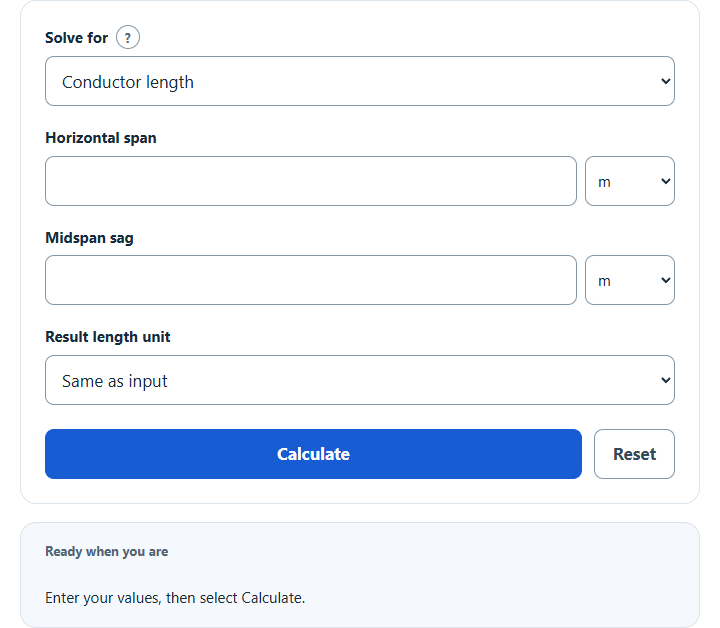
Calculate conductor or cable length from span and midspan sag, or find sag from length or from tension and conductor weight, for level supports.
- All Construction Calculators
- Conductivity ↔ Resistivity Calculator
- Chain Sag Calculator
- ZS (Earth Loop Impedance) Calculator
Calculator Functions
| Function | What it does | What it requires |
|---|---|---|
| Conductor length | Finds the length of conductor hanging between two level supports | Requires the horizontal span and the midspan sag |
| Sag from length and span | Finds the midspan sag of a known length of conductor over a span | Requires the horizontal span and the conductor length |
| Span from length and sag | Finds the horizontal span that a conductor length covers at a given sag | Requires the conductor length and the midspan sag |
| Horizontal tension | Finds the horizontal tension that holds a loaded conductor at a given sag | Requires the horizontal span, the midspan sag and the downward unit load |
| Sag from tension | Finds the midspan sag at a known horizontal tension | Requires the horizontal span, the downward unit load and the horizontal tension |
| Unit load from tension and sag | Finds the downward load per unit length that produces a given sag | Requires the horizontal span, the midspan sag and the horizontal tension |
| Span from tension and sag | Finds the horizontal span for a given sag, load and tension | Requires the midspan sag, the downward unit load and the horizontal tension |
Lengths are entered in mm, cm, m, in or ft, unit load in N/m, kg/m or lbf/ft, and tension in N, kN or lbf. A load in kg/m is turned into weight with standard gravity, 9.80665 m/s². Every function assumes level supports and a sag of no more than 5% of the span, and rejects a larger sag. Each result also lists the sag as a percentage of span, the conductor length and the span.
Conductor Length Formulas
| L | Conductor length along the curve |
| S | Horizontal span between the supports |
| f | Midspan sag, in the same unit as S |
Conductor length
The formula above applies directly. It treats the hanging conductor as a parabola, which is close to the true curve while the sag is small against the span. A 100 m span with 2 m of sag holds 100 + 8 × 2² ÷ (3 × 100) = 100.107 m of conductor, only 0.107 m more than the span.
Sag from length and span
This is the main formula solved for sag. A 100.107 m conductor over a 100 m span sags √(3 × 100 × 0.107 ÷ 8) = 2.00 m. The length must be at least the span.
Span from length and sag
÷ 2
Solving the main formula for span gives a quadratic with two roots. The calculator returns the larger one, because the smaller root describes a deep sag outside the 5% range. A 100.107 m conductor with 2 m of sag spans 100 m.
Horizontal tension
H is the horizontal tension and w is the downward load per unit length. A conductor loaded at 10 N/m over a 100 m span with 2 m of sag needs 10 × 100² ÷ (8 × 2) = 6,250 N of horizontal tension. A sag of zero is rejected.
Sag from tension
This is the parabola sag equation in its usual form. At 10 N/m, a 100 m span and 6,250 N of horizontal tension, the sag is 10 × 100² ÷ (8 × 6,250) = 2 m.
Unit load from tension and sag
A 2 m sag held by 6,250 N over a 100 m span corresponds to 8 × 2 × 6,250 ÷ 100² = 10 N/m.
Span from tension and sag
A 2 m sag at 6,250 N and 10 N/m corresponds to a span of √(8 × 2 × 6,250 ÷ 10) = 100 m.
Limits of This Estimate
- The parabola method suits spans under about 1,000 ft or sags under 5% of the span [1]. Longer or deeper spans need the catenary equation, and the calculator rejects a sag above 5% of the span.
- Supports are assumed level and the load uniform along the conductor. Unequal support heights, wind, ice, temperature change, stretch and creep are not modeled.
- H is the horizontal tension, which is the tension at midspan. The tension at the supports is slightly higher.
- The result is not a basis for clearance checks or installation sag. Those follow the applicable code and the sag-tension data for the conductor.
Sources
- U.S. Department of Agriculture, Rural Utilities Service, Bulletin 1724E-200, Design Manual for High Voltage Transmission Lines: parabola sag and tension equation, its 5% range, and the conductor length expression