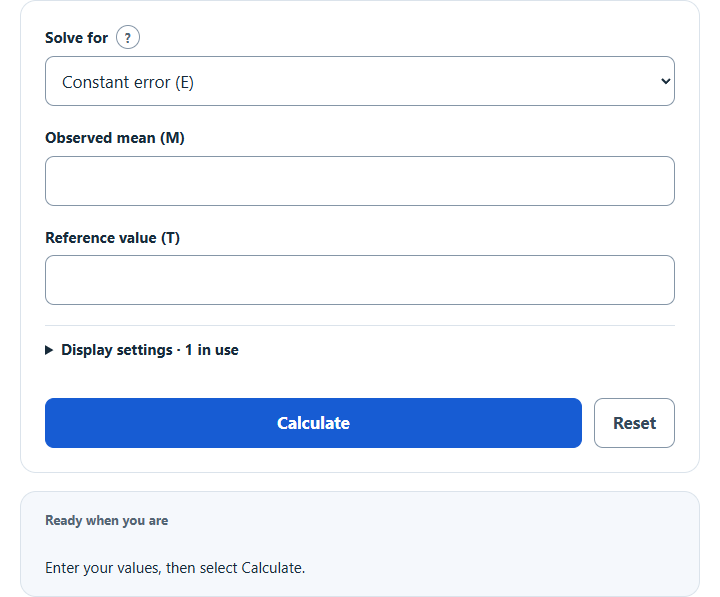
Calculate constant error by subtracting the true value from the observed mean or a list of repeated readings, with percent bias and corrected readings.
Related Calculators
- Variable Error Calculator
- Standard Error Of Measurement Calculator
- Difference Of Means Calculator
- Concordance Rate Calculator
- All Statistics Calculators
Constant Error Formula
The following formula estimates constant error (bias) by comparing the mean of repeated observations with a reference value, often called the true value in the simplified model.
Variables:
- E is the constant error
- M is the mean of observed values
- T is the true value
To calculate the constant error, subtract the true value from the mean of the observed values.
What is a Constant Error?
A constant error is an additive systematic component that remains unchanged under the specified measurement conditions. Random variation can still make individual observations fall on either side of a reference. The difference between an observed mean and a reference estimates bias; it does not by itself establish a constant offset across a range. Correcting an estimated bias does not remove measurement uncertainty.
How to Calculate Constant Error?
The following steps outline how to calculate the Constant Error.
- First, determine the mean of the observed values (M).
- Next, determine the true value (T).
- Next, calculate the constant error using the formula E = M – T.
- Finally, calculate the Constant Error.
- After inserting the values and calculating the result, check your answer with the calculator above.
Example Problem :
Use the following variables as an example problem to test your knowledge.
Mean of observed values (M) = 50
True value (T) = 45. The estimated constant error is E = 50 − 45 = 5, in the same measurement unit.