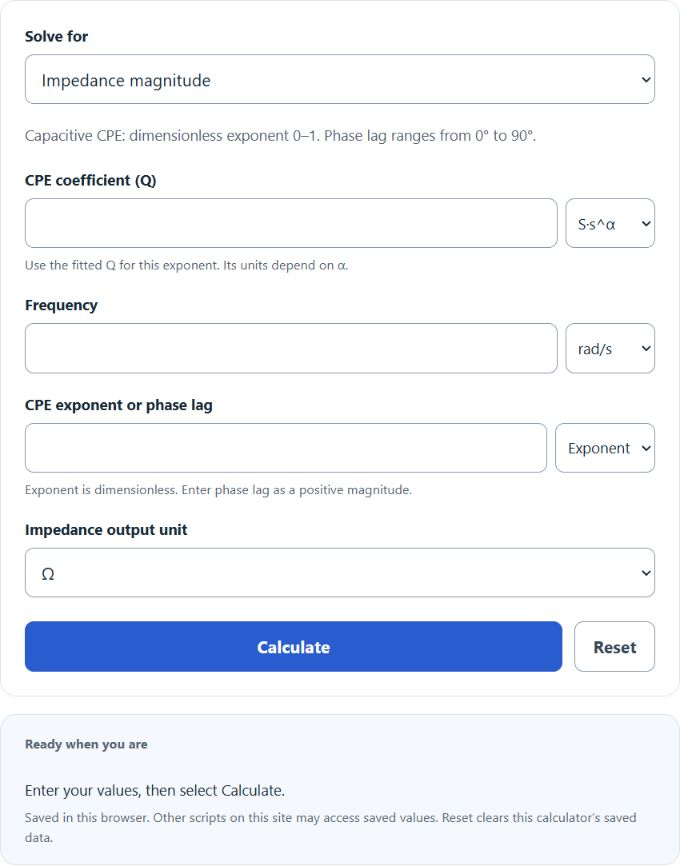
Choose impedance magnitude, Q, frequency, or dimensionless CPE exponent to solve. Capacitive exponent α ranges from 0 to 1; positive phase lag is 90°α.
Constant Phase Element Formula
The calculator uses the magnitude form of the constant phase element impedance relationship:
Rearranged formulas are used when one of the other inputs is missing:
- Z = impedance magnitude, in ohms Ω
- Q = constant phase element coefficient, in S·sα
- ω = angular frequency, in rad/s
- α = dimensionless CPE exponent, from 0 to 1 in this capacitive model
To calculate impedance, the calculator divides 1 by the product of Q and ω raised to α. To calculate Q, it rearranges the same relationship and divides 1 by Z times ω raised to α. To calculate angular frequency, it solves the power expression for ω. To calculate α, it uses logarithms to isolate the exponent.
If you enter frequency in Hz, it is converted to angular frequency using ω = 2πf before the formula is applied. If you choose phase lag in degrees or radians, its positive magnitude is converted to the exponent: α = lag/90° = 2×lag/π radians. The signed impedance phase is −90°α.
Constant Phase Element Units and Conversions
| Quantity | Accepted units | Base unit used in formula | Conversion |
|---|---|---|---|
| Impedance, Z | Ω, kΩ, MΩ | Ω | 1 kΩ = 1,000 Ω; 1 MΩ = 1,000,000 Ω |
| CPE coefficient, Q | S·sα, mS·sα, μS·sα | S·sα | 1 mS = 0.001 S; 1 μS = 0.000001 S |
| Angular frequency, ω | rad/s, Hz | rad/s | ω = 2πf |
| Exponent / phase lag | dimensionless exponent; phase lag in degrees or radians | dimensionless α | α = lag in degrees / 90 = 2×lag in radians / π |
Typical CPE Alpha Interpretation
| α behavior | Common interpretation |
|---|---|
| α close to 0 | More resistor-like behavior |
| α around 0.5 | Same frequency dependence as an ideal semi-infinite Warburg element; not proof of diffusion |
| α close to 1 | More ideal capacitor-like behavior |
Example Calculations
Example 1: Calculate impedance
Given Q = 0.0002 S·sα, ω = 100 rad/s, and dimensionless α = 0.8:
The impedance is about 125.594 Ω.
Example 2: Calculate Q
Given Z = 2 kΩ, frequency = 50 Hz, and phase lag = 45 degrees (α = 0.5):
First convert the values: Z = 2,000 Ω, ω = 314.159 rad/s, and dimensionless α = 0.5.
The CPE coefficient is about 28.2095 μS·sα.
FAQ
What is a constant phase element?
A constant phase element is a circuit element used to model non-ideal capacitive behavior, often in electrochemical impedance spectroscopy. It is useful when a real surface, coating, or interface does not behave like a perfect capacitor.
Why does impedance decrease when frequency increases?
In the formula Z = 1 / (Qωα), ω is in the denominator. For fixed Q and positive α, a larger angular frequency increases Qωα and decreases impedance magnitude. At α = 0, magnitude is 1/Q independent of frequency.
Is α the same as phase angle in every CPE model?
No. α is a dimensionless exponent. For Z = 1/[Q(jω)^α], the impedance phase is −απ/2 radians or −90°α. This calculator accepts α directly or positive phase lag magnitude. Q uses S·sα and is capacitance only at α = 1. Exponent inverses use the numerical SI coefficient and angular frequency; one point does not fit a spectrum. At ω = 1 rad/s the exponent inverse is nonunique or inconsistent; at α = 0 the frequency inverse is nonunique or inconsistent.