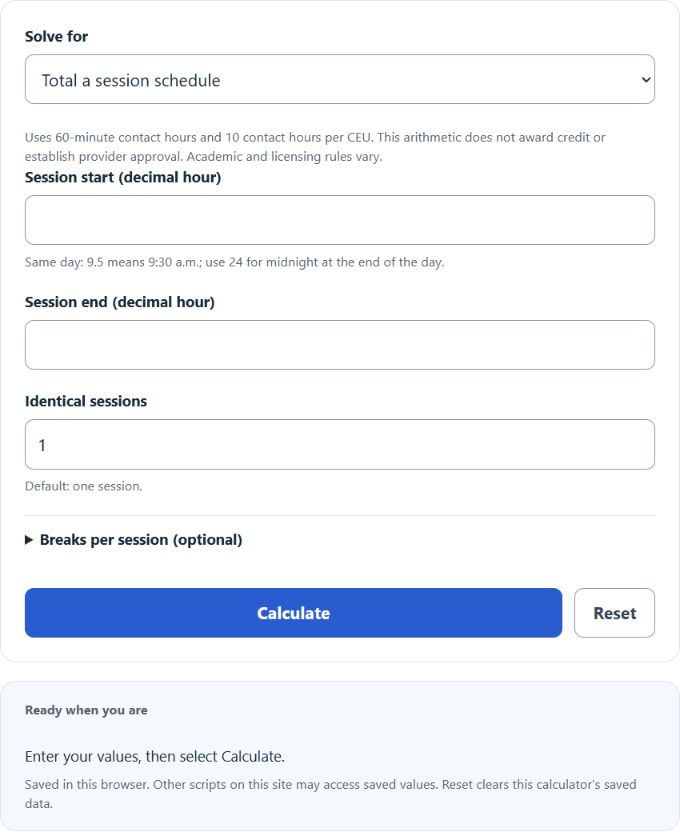
Calculate instructional contact hours from session times and breaks, convert minutes and clock hours, and show IACET CEUs or custom academic-hour units.
- All Unit Converters
- Cost Per Credit Hour Calculator
- Completion Ratio Calculator
- QPA (Quality Point Average) Calculator
Contact Hour Formula
Contact hours = instructional minutes ÷ 60.
CEUs = contact hours ÷ 10.
Variables:
- Contact hours here use 60 instructional minutes per hour.
- Instructional minutes exclude noninstructional breaks.
- Custom academic units = instructional minutes / minutes per unit.
For a schedule, subtract breaks from each session and multiply by the number of identical sessions. For a custom unit, enter its institution-defined length in minutes.
What Is a Contact Hour?
This calculator uses a 60-minute contact hour for continuing-education arithmetic. Academic contact-hour definitions may use different instructional periods. Contact time, academic credit and total student work are distinct; use your institution or licensing body’s definition.
Contact-to-credit ratios depend on the institution, course type and accreditor. Lecture, laboratory, clinical and internship rules can differ. The custom-unit mode divides actual instructional minutes by the unit length you supply; it does not determine academic credits.
The Carnegie Unit and Federal Regulation
Historical Carnegie-style scheduling conventions should not be confused with the 60-minute continuing-education unit used here. Institutions determine credit equivalencies under the applicable regulatory and accreditation framework.
The credit-hour definition in 34 CFR 600.2 generally references one hour of instruction and at least two hours of out-of-class work each week for about 15 weeks, or equivalent work. It allows institutional judgment across delivery methods and activities; it does not establish one universal 50-minute-to-CEU conversion.
Contact Hours by Course Type
The following are illustrative academic scheduling ratios, not universal requirements or the calculator’s 60-minute contact-hour definition. Confirm both period length and credit policy locally:
| Course Type | Contact Hours per Credit Hour | Total for a 3-Credit, 15-Week Course |
|---|---|---|
| Lecture / Seminar / Discussion | 1:1 | 45 contact hours |
| Studio / Art / Design | 2:1 | 90 contact hours |
| Self-Directed Laboratory | 2:1 to 3:1 | 90 to 135 contact hours |
| Clinical / Practicum | 3:1 | 135 contact hours |
| Internship / Field Work | ~10 hrs/week for 3 credits | 150 to 200 hours per semester |
Online and other delivery formats require appropriate equivalent academic work under the institution’s approved credit policy. Do not infer credit eligibility from this duration calculator alone.
Contact Hours in Continuing and Professional Education
In professional licensing and continuing education, the contact hour carries a related but distinct meaning. Healthcare, social work, education, and legal professions mandate a set number of contact hours per license renewal cycle. In these contexts, a contact hour is typically defined as 60 minutes of approved instruction rather than the academic 50-minute period. This difference matters when attempting to transfer CE credits between professional and academic contexts.
IACET defines one CEU as ten contact hours in an organized learning experience. College Board’s IACET guidance uses a 60-minute contact hour. Licensing requirements, approved activities and accepted units vary by jurisdiction and profession; this calculation does not certify acceptance.
Compressed Terms and Non-Standard Calendars
For an institution using 15 instructional periods per semester credit, a 3-credit course distributes 45 periods over its term: about 6.43 periods per week over seven weeks. Period length and independent work must be specified separately. The calculator totals actual instructional minutes rather than inferring them from credits.
Quarter and semester calendars can use different credit equivalencies. A receiving institution determines transfer credit; neither the CEU mode nor custom-duration units establish that equivalence.