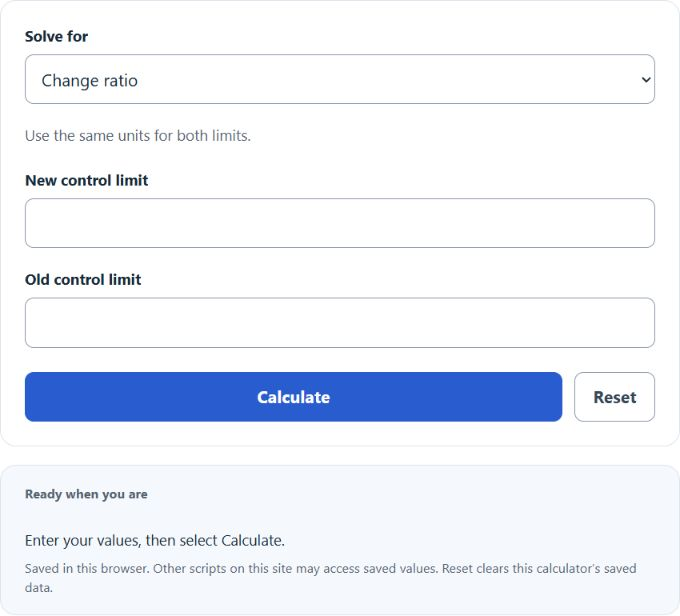
Choose the value to solve for, then enter the other two. Use the same units for both control limits.
Control Limit Change Ratio Formula
The control limit change ratio measures the relative change from an old control limit to a new control limit. Choose a solve direction and enter the other two values. The old limit must be nonzero; signed limits are supported.
- R = control limit change ratio
- N = new control limit
- O = old control limit
To calculate the new control limit when you know the old control limit and the change ratio, the formula is:
To calculate the old control limit when you know the new control limit and the change ratio, the formula is:
- Calculate change ratio: use the old and new control limits to find the proportional increase or decrease.
- Calculate new control limit: apply the change ratio to the old control limit.
- Calculate old control limit: reverse the change ratio from the new control limit.
Control Limit Change Ratio Interpretation
The ratio is returned as a decimal; the input accepts a decimal or percentage. Multiply a decimal ratio by 100 to express it as a percentage. The interpretation below assumes a positive old limit.
| Change Ratio | Percent Change | Meaning |
|---|---|---|
| 0.25 | 25% increase | The new control limit is 25% higher than the old control limit. |
| 0.10 | 10% increase | The new control limit is slightly higher. |
| 0 | 0% | No change between the old and new control limits. |
| -0.10 | 10% decrease | The new control limit is 10% lower than the old control limit. |
| -0.25 | 25% decrease | The new control limit is much lower than the old control limit. |
Example Calculations
Example 1: Find the control limit change ratio
Suppose the old control limit is 80 and the new control limit is 92.
The control limit change ratio is 0.15, which means the control limit increased by 15%.
Example 2: Find the new control limit
Suppose the old control limit is 120 and the change ratio is -0.20.
The new control limit is 96.
FAQs
How do I enter a percent change?
Select percent to enter 12, or decimal to enter 0.12. A ratio of -0.12 is a 12% decrease relative to a positive old limit.
What does a negative control limit change ratio mean?
With a positive old limit, a negative ratio means the new limit is lower; -0.05 represents a 5% decrease. For a negative old limit, the ratio sign reverses this interpretation. The calculator also reports whether the new value is numerically higher or lower.
Can the old control limit be zero?
No. The change ratio formula divides by the old control limit, so the old control limit cannot be zero. If the old limit is zero, the relative change ratio is undefined. When solving for the old limit, a ratio of -1 and a new limit of zero do not give a unique answer; a ratio of -1 with a nonzero new limit is inconsistent.