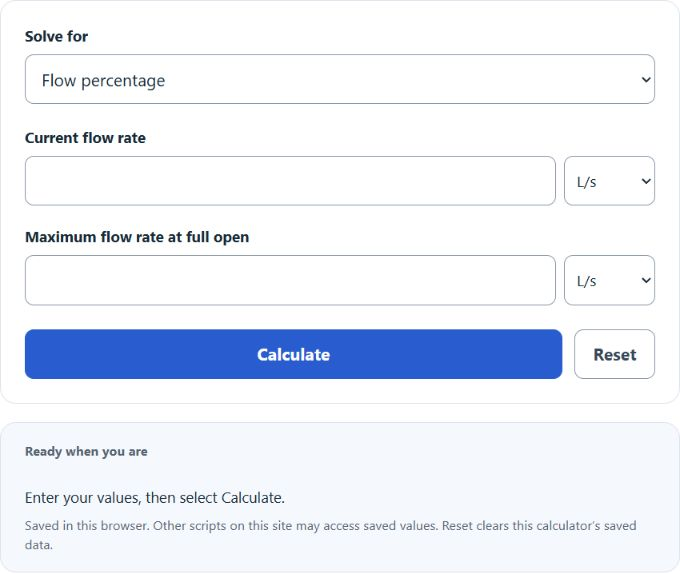
Calculate percentage of full-open flow, or estimate flow using a proportional model. Actual valve travel requires valve and system characteristics. Supports m³/s, L/s and US gpm.
Control Valve Flow Percentage Formula
The calculator uses a simple linear flow percentage method. It treats the current flow as a percentage of the maximum flow measured or specified at 100% open.
- P = flow percentage, an approximate percent open only for a linear valve characteristic at unchanged pressure drop and fluid conditions
- Q = current flow rate
- Qmax = maximum flow rate at 100% open
- Q = estimated flow rate at the entered percentage
- P = percentage of full-open flow
- Qmax = maximum flow rate at 100% open
Flow percentage divides the current flow rate by the maximum flow rate and multiplies by 100. For example, a valve passing 45 L/s when its maximum is 100 L/s is at 45% of maximum flow.
Estimated flow rate reverses the formula. It multiplies the maximum flow rate by the entered percentage to estimate the flow rate at that percentage.
Flow fraction can approximate travel only for a linear characteristic with unchanged pressure drop and fluid conditions. Installed system behavior and equal-percentage or quick-opening characteristics can produce a different relationship. This calculator is not a valve sizing or operating recommendation.
Control Valve Flow Percentage Ranges
| Flow percentage | General interpretation | Common note |
|---|---|---|
| 0% to 10% | Very low flow | This fraction alone does not diagnose throttling or valve sizing. |
| 10% to 25% | Low flow | Travel and control resolution require the valve characteristic and system conditions. |
| 25% to 75% | Mid-range flow | A mid-range flow fraction does not establish stable control. |
| 75% to 95% | High flow | High flow fraction does not prove a corresponding stem position. |
| 95% to 100% | Near maximum flow | Near the entered maximum under the assumed conditions; changed pressure drop may change capacity. |
Flow Unit Reference
| Unit | Meaning | Conversion to m³/s |
|---|---|---|
| m³/s | Cubic meters per second | 1 m³/s |
| L/s | Liters per second | 0.001 m³/s |
| gpm | US gallons per minute | 0.0000630901964 m³/s |
Example Calculations
Example 1: Find percentage of full-open flow
You have a current flow rate of 45 L/s and a maximum flow rate of 100 L/s.
The control valve is flowing at approximately 45% of its maximum flow.
Example 2: Find flow rate from percentage
You enter 60% of full-open flow and a maximum flow rate of 250 US gpm.
The estimated flow rate is 150 gpm.
FAQs
Is flow percentage the same as actual valve position?
Not always. This calculation shows the current flow as a percentage of maximum flow. Actual valve travel or stem position can be different, especially for equal-percentage, quick-opening, or characterized control valves.
Why do the current flow and maximum flow need to use the same unit?
The percentage formula is a ratio. The quantities must use the same unit when divided. You may select different input units here; the calculator converts them to m³/s before taking the ratio.
Can the result be greater than 100%?
Yes, if the entered current flow is greater than the entered maximum flow. Check the entered maximum, measurements and operating conditions. A value above 100% is a flow fraction relative to that entered reference, not physical travel beyond fully open.