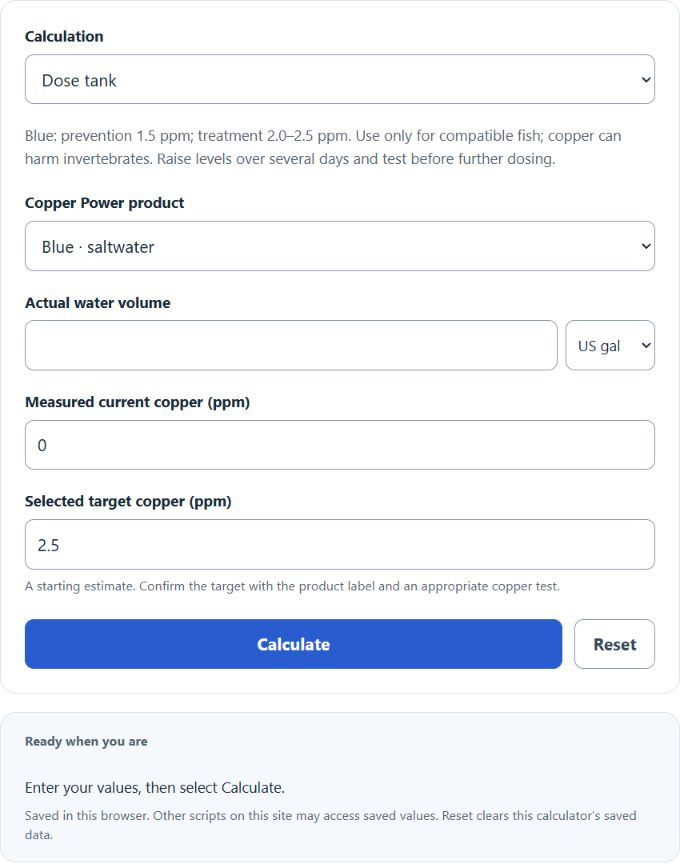
Calculate Copper Power dosage for aquariums by volume in gallons or liters, current and target ppm, or water changes for saltwater and freshwater.
Copper Power Dosing Formula
The calculator uses one base formula and rearranges it for each mode. The dosing rate depends on the product strength.
- mL = volume of Copper Power to add
- Gallons = actual water volume being treated (liters ÷ 3.785411784)
- Rate = approximately 0.59147059125 mL per US gal per ppm for Copper Power Blue (saltwater), or 2.365882365 for Copper Power Green (freshwater)
- ΔppmCu = target ppm minus current ppm
The current manufacturer product sheets specify 6 US teaspoons (1 US fluid ounce) per 20 US gallons for approximately 2.5 ppm with Blue or 0.625 ppm with Green; Green uses 12 teaspoons for approximately 1.25 ppm. The calculator uses 1 US fl oz = 29.5735295625 mL consistently, while the manufacturer rounds it to approximately 30 mL. These are starting estimates that require copper testing. Sources: Blue product sheet and Green product sheet.
Each mode applies the formula differently:
- Dose tank: Δppm is target minus current, applied across the full tank volume. If the target is at or below current copper, add no product. A lower-target dilution estimate assumes complete mixing and copper-free replacement water; it does not prescribe a safe water-change procedure.
- Water change: Δppm equals the maintained ppm, applied only to copper-free replacement water, assuming the tank starts at that maintained level.
- Mix new water: Δppm equals the target ppm, applied to the new batch volume (assumes 0 ppm starting copper).
Reference Values
Manufacturer reference levels for compatible ornamental aquarium fish. Blue and Green have different targets. Raise levels over several days, test regularly, and remove fish immediately if stress appears. These figures do not establish suitability for a particular fish.
| Use case | Target ppm Cu | Notes |
|---|---|---|
| Blue: saltwater treatment | 2.0 to 2.5 | Manufacturer describes approximately 14 to 30 days with periodic testing |
| Blue: prevention | 1.5 | Manufacturer prevention reference |
| Freshwater parasite treatment | 1.0 to 1.25 | Use Copper Power Green |
| Green: prevention | 0.625 | Manufacturer prevention reference |
| Product | mL per gallon per ppm | Example for 20 US gal |
|---|---|---|
| Copper Power Blue | 0.59147059125 | 29.57 mL → approximately 2.5 ppm |
| Copper Power Green | 2.365882365 | 59.15 mL → approximately 1.25 ppm |
Examples and FAQ
Example 1: Initial dose. You have a 30-gallon saltwater QT at 0 ppm and want to reach 2.5 ppm with Copper Power Blue. mL ≈ 30 × 0.59147059125 × 2.5 = 44.36 mL. The manufacturer recommends increasing over several days with copper testing; it does not specify a fixed increment or 12-hour schedule.
Example 2: Water change top-up. Your 40-gallon QT is held at 2.0 ppm and you swap 25%, or 10 gallons. Dose the replacement water (not the tank) with 10 × 0.59147059125 × 2.0 ≈ 11.83 mL of Copper Power Blue, then add it.
Why dose the new water instead of the tank? Pre-dosing the replacement water keeps the tank closer to the target through the change under the calculator’s complete-mixing assumption. Test the replacement water and tank; actual concentrations may differ.
Do I include rock, sand, or decorations in the volume? Use the actual water volume. Subtract a rough displacement estimate if the tank is heavily aquascaped, and verify the usable water volume rather than assuming the rated tank size equals water volume.
Why ramp up over several doses? The manufacturer recommends increasing copper over several days and monitoring fish and copper measurements. No fixed daily ppm increment is specified. Blue’s upper treatment reference is 2.5 ppm; Green’s is 1.25 ppm. Remove fish immediately if stress appears.
Can I use this for invertebrates or scaleless fish? Copper Power product sheets warn that copper harms snails and invertebrates. Fish compatibility must be checked against the current product label and qualified aquarium guidance; this calculator cannot establish species safety. Use a dedicated hospital tank as directed, do not mix medications, and never use these products for fish intended for human consumption.