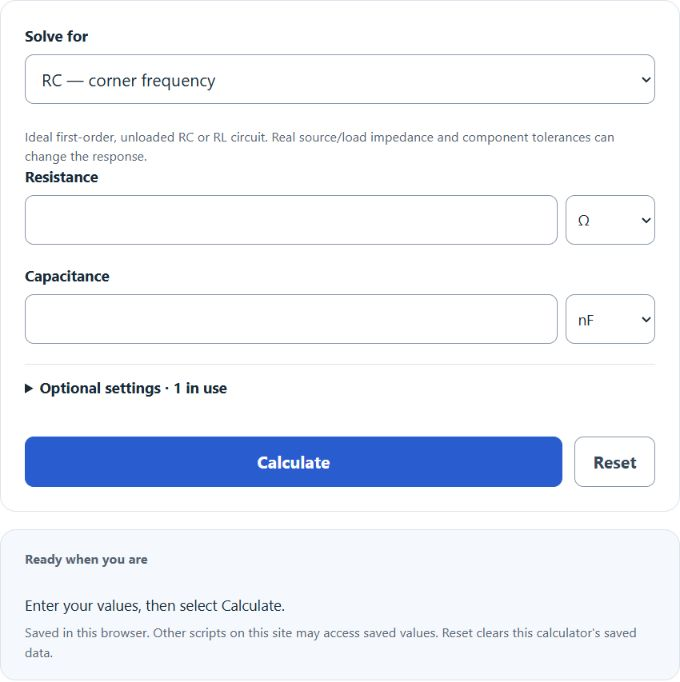
Calculate RC or RL corner frequency, reverse-size resistance, capacitance or inductance, convert time constant, and check ideal filter magnitude and phase.
- All Physics Calculators
- All Frequency Calculators
- Frequency To Time Constant Calculator
- Frequency To Energy Calculator
- Sheet Resistance Calculator
Corner Frequency Formula
The corner frequency (also called the cutoff or -3 dB frequency) is the point where a first-order filter’s output power drops to half of its passband value.
RC filter:
RL filter:
From time constant τ:
- fc: corner frequency in hertz (Hz)
- R: resistance in ohms (Ω)
- C: capacitance in farads (F)
- L: inductance in henries (H)
- τ: time constant in seconds, where τ = RC for RC circuits and τ = L/R for RL circuits
These formulas assume an ideal first-order passive filter with no loading effects. Angular corner frequency is ωc = 2πfc. At fc, the normalized voltage gain is -3.01 dB and the phase shift is -45° for low-pass or +45° for high-pass. The optional response check assumes unity passband gain; high-pass phase is undefined at DC because its output is zero.
Reference Tables
Common RC pairs and the corner frequency they produce:
| R | C | τ = RC | fc |
|---|---|---|---|
| 1 kΩ | 1 µF | 1 ms | 159.2 Hz |
| 10 kΩ | 100 nF | 1 ms | 159.2 Hz |
| 10 kΩ | 10 nF | 100 µs | 1.592 kHz |
| 1 kΩ | 1 nF | 1 µs | 159.2 kHz |
| 100 Ω | 100 pF | 10 ns | 15.92 MHz |
How the response behaves around fc in a first-order filter:
| Frequency | Gain (low-pass) | Phase shift |
|---|---|---|
| 0.1 × fc | -0.04 dB | -5.7° |
| 0.5 × fc | -1.0 dB | -26.6° |
| fc | -3.01 dB | -45° |
| 2 × fc | -7.0 dB | -63.4° |
| 10 × fc | -20 dB | -84.3° |
Example and Common Questions
Example: An RC low-pass filter uses R = 4.7 kΩ and C = 33 nF.
τ = (4700)(33 × 10⁻⁹) = 155.1 µs
fc = 1 / (2π × 155.1 µs) ≈ 1026 Hz
Is corner frequency the same as cutoff frequency? Yes. Both terms refer to the -3 dB point of a first-order filter. “Break frequency” is also used.
Does it matter if the filter is low-pass or high-pass? No. For a first-order RC or RL filter, the corner frequency formula is the same. Only the direction of the rolloff changes.
Why -3 dB? At fc, the output voltage is 1/√2 (about 70.7%) of the input, which corresponds to half the power. In decibels, that is 20·log₁₀(1/√2) ≈ -3.01 dB.
How do I pick standard parts? Select an RC or RL resistance, capacitance or inductance solve mode, then round to the nearest E12 or E24 value. Recompute fc with the rounded value to confirm it stays within tolerance.