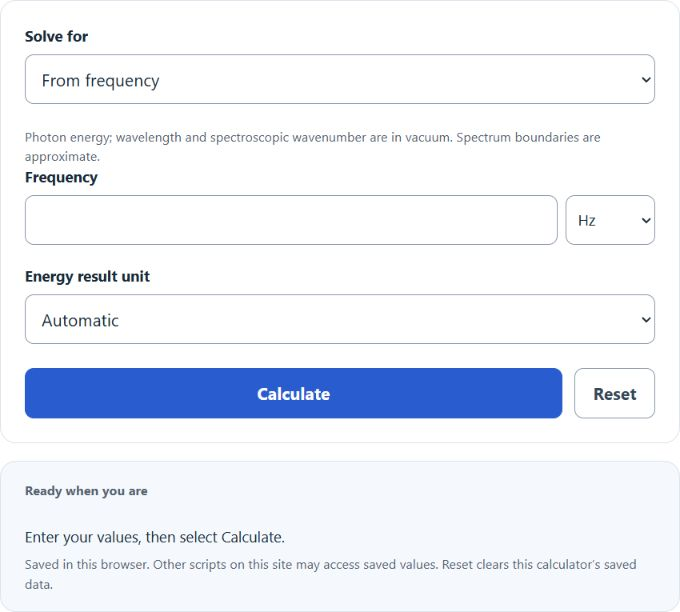
Calculate photon energy, frequency, wavelength, and wavenumber from any one input, with spectrum region shown for radio to gamma rays.
- All Physics Calculators
- Waves, Optics, and Quantum Unit Converters
- All Energy Calculators
- Wavelength to Energy Calculator
- Energy to Wavelength Calculator
- Wavenumber to Energy Calculator
Frequency To Energy Formula
The calculator converts between photon frequency, vacuum wavelength, and energy using the Planck relation and the vacuum speed of light.
- E = photon energy in joules (J)
- f = frequency in hertz (Hz)
- λ = wavelength in meters (m)
- h = Planck constant = 6.62607015 × 10⁻³⁴ J·s
- c = speed of light in vacuum = 299,792,458 m/s
Select the calculation path matching the known value:
- Frequency path. You enter f. The calculator returns E from E = h·f and λ from λ = c/f.
- Wavelength or wavenumber path. You enter λ (or a wavenumber in cm⁻¹, which is converted with λ = 1/wavenumber). It returns f = c/λ and E = h·c/λ.
- Photon-energy path. You enter E in any supported unit. It returns f = E/h and λ = c/f.
Energy results are also shown in eV, kJ/mol, and kcal/mol. The conversion to eV uses 1 eV = 1.602176634 × 10⁻¹⁹ J. Per-mole values use Avogadro’s number, 6.02214076 × 10²³ mol⁻¹.
Reference Tables
Use these tables to sanity-check a result. Spectrum boundaries are approximate vacuum-wavelength conventions, with overlapping definitions; the visible band used here is 380–750 nm.
| Region | Wavelength | Frequency | Photon energy |
|---|---|---|---|
| Radio | > 1 m | < 300 MHz | < 1.2 µeV |
| Microwave | 1 mm – 1 m | 300 MHz – 300 GHz | 1.2 µeV – 1.2 meV |
| Infrared | 750 nm – 1 mm | 300 GHz – 400 THz | 1.2 meV – 1.65 eV |
| Visible | 380 – 750 nm | 400 – 790 THz | 1.65 – 3.26 eV |
| Ultraviolet | 10 – 380 nm | 790 THz – 30 PHz | 3.26 – 124 eV |
| X-ray | 0.01 – 10 nm | 30 PHz – 30 EHz | 124 eV – 124 keV |
| Gamma | < 0.01 nm | > 30 EHz | > 124 keV |
| Energy unit | Equivalent in joules |
|---|---|
| 1 eV | 1.602177 × 10⁻¹⁹ J |
| 1 kJ/mol | 1.660539 × 10⁻²¹ J per photon |
| 1 kcal/mol | 6.947695 × 10⁻²¹ J per photon |
| 1 hartree | 4.359745 × 10⁻¹⁸ J |
| 1 cm⁻¹ (wavenumber) | 1.986446 × 10⁻²³ J |
Worked Examples
Example 1: Green light at 520 nm. Convert to frequency and energy.
f = c / λ = (2.998 × 10⁸ m/s) / (5.20 × 10⁻⁷ m) = 5.765 × 10¹⁴ Hz.
E = h · f = (6.626 × 10⁻³⁴ J·s)(5.765 × 10¹⁴ Hz) = 3.820 × 10⁻¹⁹ J = 2.384 eV.
Example 2: A 2.45 GHz microwave photon.
E = h · f = (6.626 × 10⁻³⁴)(2.45 × 10⁹) = 1.623 × 10⁻²⁴ J = 1.013 × 10⁻⁵ eV.
λ = c / f = (2.998 × 10⁸) / (2.45 × 10⁹) = 0.1224 m.
FAQ
Why is photon energy proportional to frequency, not wavelength? The Planck relation E = h·f comes from quantum theory. Frequency counts oscillations per second, and each photon carries one quantum of that oscillation. Wavelength is just c/f, so longer wavelengths mean lower frequency and lower energy.
What’s the quick shortcut for nm to eV? E (eV) ≈ 1240 / λ (nm). It’s accurate to about four digits and works well for visible, UV, and near-IR light.
When should I use kJ/mol instead of eV? Use kJ/mol or kcal/mol when comparing photon energy to chemical bond energies or activation energies. Use eV for single-photon physics, spectroscopy, and semiconductor band gaps.
What does a wavenumber in cm⁻¹ mean? Wavenumber is 1/λ expressed per centimeter. It’s standard in IR spectroscopy. Multiply cm⁻¹ by 100 to get m⁻¹, then take the reciprocal to get wavelength in meters.