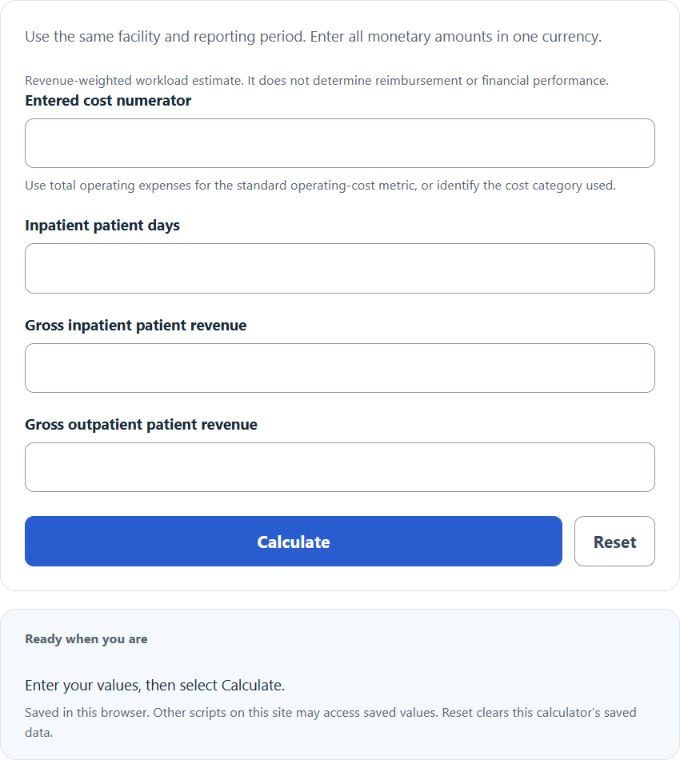
Calculate cost per adjusted patient day, total operating expenses, patient days, outpatient visits, or conversion factor from the other inputs.
Methodology note: This calculator uses Adjusted patient days = TPD + (TOV ÷ CF), where CF is the number of outpatient visits per 1 patient-day equivalent (e.g., CF = 2 means 2 visits = 1 adjusted patient day). Definitions vary by organization—confirm the convention used by your facility or common hospital finance/benchmarking references (e.g., HFMA/AHA-style guidance). For informational/administrative use only; not accounting, reimbursement, or financial advice.
Related Calculators
- Bed Days Available Calculator
- Healthcare Productivity Calculator
- Patient Year Exposure Calculator
- Prevalence Calculator
- All Health and Medical Calculators
Cost Per Adjusted Patient Day Formula
The cost per adjusted patient day is calculated by dividing total operating expenses by adjusted patient days. Adjusted patient days combine inpatient days with an outpatient volume adjustment.
APD = TPD + (TOV / CF)
CPAPD = TOE / APD
Combined into one formula:
CPAPD = TOE / (TPD + (TOV / CF))
The calculator can also rearrange the formula to solve for any one missing value:
TOE = CPAPD * (TPD + (TOV / CF))
TPD = (TOE / CPAPD) - (TOV / CF)
TOV = CF * ((TOE / CPAPD) - TPD)
CF = TOV / ((TOE / CPAPD) - TPD)
- CPAPD = cost per adjusted patient day, in dollars
- TOE = total operating expenses, in dollars
- APD = adjusted patient days
- TPD = total inpatient patient days
- TOV = total outpatient visits
- CF = conversion factor, measured as outpatient visits per one patient-day equivalent
If you leave cost per adjusted patient day blank, the calculator divides total operating expenses by adjusted patient days. If you leave total operating expenses blank, it multiplies cost per adjusted patient day by adjusted patient days. If you leave patient days, outpatient visits, or the conversion factor blank, it rearranges the same relationship to solve for that missing input.
Conversion Factor and Result Reference
The conversion factor controls how outpatient visits are converted into patient-day equivalents. A lower conversion factor gives each outpatient visit more weight. A higher conversion factor gives each outpatient visit less weight.
| Conversion Factor | Meaning | Outpatient Visits Equal to 1 Adjusted Patient Day |
|---|---|---|
| 1.0 | Each outpatient visit counts the same as one patient day | 1 visit |
| 2.0 | Two outpatient visits count as one patient-day equivalent | 2 visits |
| 4.0 | Four outpatient visits count as one patient-day equivalent | 4 visits |
| Result Pattern | What It Usually Indicates |
|---|---|
| Higher cost per adjusted patient day | Expenses are high relative to inpatient and adjusted outpatient volume. |
| Lower cost per adjusted patient day | Expenses are spread across more adjusted patient days, or expenses are lower for the volume served. |
| Large change after changing the conversion factor | Outpatient volume is a major part of the adjusted patient day total. |
Example Calculations
Example 1: Calculate cost per adjusted patient day
Suppose total operating expenses are $12,000,000, total patient days are 18,000, total outpatient visits are 24,000, and the conversion factor is 2.
APD = 18000 + (24000 / 2) = 30000
CPAPD = 12000000 / 30000 = 400
The cost per adjusted patient day is $400.00.
Example 2: Calculate total operating expenses
Suppose cost per adjusted patient day is $650, total patient days are 10,000, total outpatient visits are 8,000, and the conversion factor is 4.
APD = 10000 + (8000 / 4) = 12000
TOE = 650 * 12000 = 7800000
The total operating expenses are $7,800,000.00.
FAQ
What is an adjusted patient day?
An adjusted patient day is a volume measure that combines inpatient patient days with an outpatient adjustment. In this calculator, outpatient visits are converted into patient-day equivalents by dividing outpatient visits by the conversion factor.
What conversion factor should you use?
Use the conversion factor required by your facility, reporting method, or internal finance policy. For example, a conversion factor of 2 means 2 outpatient visits equal 1 adjusted patient day. Different organizations may use different methods, so the same expenses and volume can produce different results if the conversion factor changes.
Why does the calculator require only one blank field?
The formula has five related values. To solve for one missing value, the other four values must be known. If more than one field is blank, there is not enough information to calculate a single answer.