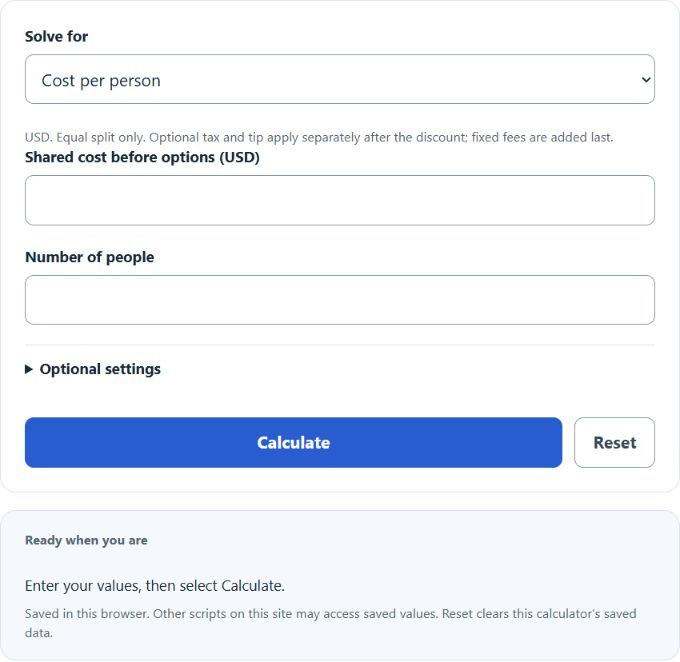
Calculate cost per person, total group cost, or affordable group size with optional tax, tip, fees, and discounts for bills, trips, meals, and events.
Cost Per Person Formula
The following equation is used to calculate the Cost Per Person.
- Where CPP is the cost per person ($/person)
- TC is the total cost ($)
- P is the number of people
To calculate the cost per person, divide the total cost by the number of people sharing the expense.
What is Cost Per Person?
Cost per person is the per-unit economics of human groups: the average share of a total expense allocated to each individual participant. It applies across virtually every domain where costs are distributed among multiple people, from splitting a restaurant bill to measuring a nation’s healthcare expenditure per capita. The result is a single, comparable number that strips away group size and isolates what the experience or service actually costs at the individual level.
The calculation works in both directions. Given a per-person budget target, you can determine the maximum total a group can spend. Given the total, you can determine each individual’s share. Both directions are essential in event planning, travel coordination, government policy, and corporate budgeting.
Real-World Cost Per Person Benchmarks
The following historical 2024–2025 figures provide context only, not current quotes or validated calculator defaults. Cost scope, geography, guest count and inclusions vary; obtain a current itemized quote for your own budget.
| Context | Cost Per Person | Notes |
|---|---|---|
| Office lunch catering | $15 to $21 | NYC and SF at top end; Midwest lowest |
| Corporate buffet catering | $25 to $65 | Food only; excludes venue, AV, staffing |
| Corporate plated dinner | $60 to $100+ | Full staffing, multi-course, premium ingredients |
| Individual business meal | ~$55 average | $55 is about 27.9% above $43; historical comparison |
| Formal dinner / gala | $125 to $180 | Multi-course with attended service |
| Wedding catering only | $62 to $123 | National average $80/person in 2024 (The Knot) |
| Wedding total, all-in | ~$284 average | Avg. $33,000 wedding / 116 guests, 2024 |
| Hotel accommodation | $125 to $225/night | Per person when room is shared |
Fixed vs. Variable Costs: How Group Size Shifts Per-Person Spending
One of the most consequential insights hidden in the cost-per-person calculation is the fixed vs. variable cost distinction. Fixed costs (venue rental, flat entertainment fees, equipment rental, minimum service charges) do not increase with headcount, so adding more people dilutes each individual’s share of those costs. Variable costs (food, beverages, printed programs, favors) scale linearly with guest count, holding constant per person regardless of group size.
A practical illustration: a 20-person dinner with a $600 flat venue fee and $35/person catering has a per-person total of ($600 / 20) + $35 = $65. Double attendance to 40 people and the per-person total drops to ($600 / 40) + $35 = $50, a 23% reduction driven entirely by the fixed cost spreading across more attendees. This is the economic logic behind scaling events: increasing headcount aggressively lowers effective cost per person when fixed costs represent a meaningful portion of the total. Once fixed costs are fully diluted, each additional guest only adds the marginal variable cost per head.
Hidden Costs That Inflate the True Per-Person Figure
The cost per person derived from a quoted contract price rarely matches what you actually pay. Several additions reliably inflate the effective per-person figure. Taxes and gratuity together can add 25 to 35% to food and beverage costs. On an $80/person catering quote, a 9% sales tax and 20% gratuity bring the real per-person cost to approximately $103. Service charges at hotels and event venues, commonly 18 to 24%, are typically mandatory and applied before gratuity is calculated, stacking costs further.
No-shows and guaranteed minimums create a structural overpayment. Most caterers and venues charge based on a guaranteed headcount, not actual attendance. If you guarantee 100 guests but only 85 attend, you pay for 100 and your effective per-person cost rises 18% above the planned figure. Event planners broadly recommend a 10 to 20% contingency buffer in total budgets to absorb this and other unplanned expenses.
Cost Per Person at Scale: Government and Institutional Per Capita Spending
At the macro level, cost per person becomes per capita spending: the same arithmetic applied to entire populations. These figures describe average expenditure; they do not by themselves measure efficiency, outcomes, or comparability across populations. In 2024, U.S. total healthcare spending reached $5.3 trillion, equating to $15,474 per person, representing 18.0% of GDP. This is the highest per-capita healthcare expenditure of any high-income nation. By comparison, Census reported $15,633 in current spending per public-school pupil for FY2022. Separately, FY2023 revenues per pupil were $9,077 from state sources and $8,662 from local sources; revenues are funding measures, not spending per pupil.
The arithmetic is identical to splitting any group expense. What changes is that policymakers working with per-capita figures must account for geographic variation, demographic differences in consumption, and the distinction between average and marginal cost; the same fixed vs. variable structure that shapes event budgeting applies at population scale.
Regional Variation and Its Effect on Per-Person Budgeting
Geography systematically shifts cost per person across nearly every category. Wedding data from The Knot’s 2025 Real Weddings Study quantifies this clearly: the average total wedding cost in New Jersey was $57,000 versus $18,000 in Utah. At a comparable guest count of 116, New Jersey couples paid roughly $491 per guest versus $155 per guest in Utah, a 3x difference for a structurally similar event.
Corporate catering shows the same pattern at smaller scale. Office lunch catering in New York City and San Francisco runs $20 to $21 per person while teams in Houston and Denver access comparable quality under $18. For a weekly team lunch of 30 people, that $3/person regional premium compiles to over $4,680 annually. Regional cost intelligence is an actionable input when a team is choosing between cities for a retreat or conference.
FAQ
What costs should I include in the total when using this calculator?
Enter the shared base cost, then optionally enter a discount, tax, tip/service rate, and fixed fees. Tax and tip apply separately after discount and are rounded separately to cents; fees are added last. If taxes or tips are already in the base cost, leave those options blank. Separate unequal personal extras before splitting. The average may contain fractional cents; the displayed cent allocation reconciles exactly to the total.
How does adding more people affect the cost per person?
It depends on the cost structure. Variable costs (food, beverages, individual materials) stay constant per person regardless of group size. Fixed costs (venue rental, flat fees, equipment) decrease per person as headcount grows because the same cost spreads across more people. Most real events carry both, so adding guests lowers the per-person contribution from fixed costs while leaving variable costs unchanged.
Does cost per person include taxes and gratuity?
In Cost per person mode, enter those amounts in the base cost or use the optional tax and tip/service fields, without double counting. Follow the actual contract and applicable tax rules. The other two modes use the final per-person amount directly and add no optional charges.
What contingency should I add to my per-person budget for an event?
Event planners consistently recommend 10 to 20% above your projected total. At a $60/person budget for 80 guests ($4,800 total), a 15% contingency reserve adds $720, bringing your working budget to $5,520. This absorbs guaranteed minimum charges from no-shows, last-minute additions, vendor price variances, and incidental costs that regularly emerge during execution.