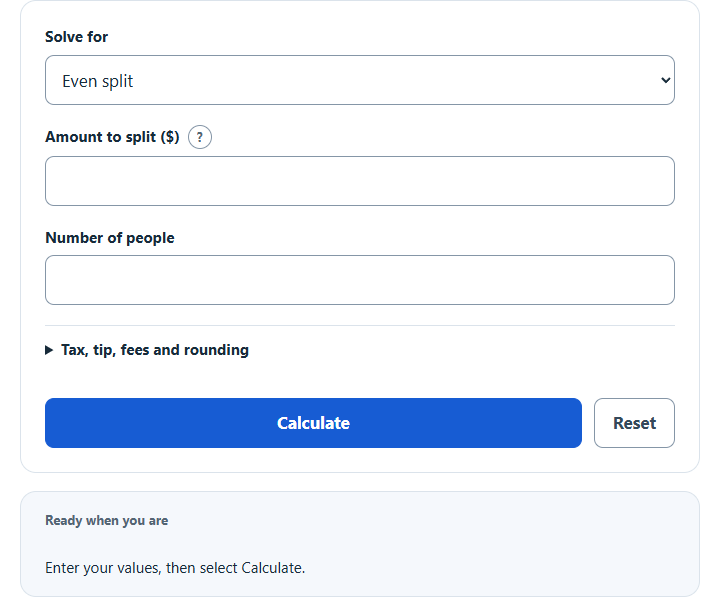
Split a payment or bill equally between any number of people, or by what each person owes, with optional tax, tip, fees, discounts and rounding.
Calculator Functions
| Function | What it does | What it requires |
|---|---|---|
| Even split | Divides a bill equally between a number of people | Requires the amount to split and the number of people |
| Itemized split | Divides a bill in proportion to what each person ordered | Requires one line per person with a name and a subtotal, such as Alex | 25 |
Both functions accept an optional tax rate and tip rate, a service fee and a discount, each as a percent of the subtotal or a fixed dollar amount, and a rounding rule for the suggested payments. The tip can be based on the subtotal or on the subtotal plus tax. Blank rates count as 0%.
Split Payment Formulas
| Total | Subtotal + tax + tip + service fee − discount, never less than $0 |
| N | Number of people |
| S | Subtotal before tax and tip ($) |
Even split
The formula above applies directly. A $120 bill between 4 people is $30 each. A $100 subtotal with 8% tax and a 20% tip on the subtotal comes to 100 + 8 + 20 = $128, or $32 each.
Itemized split
own subtotal ÷ S
Each person pays the same fraction of the total as their fraction of the subtotal, so tax, tip, fees and discounts are shared in proportion. If Alex ordered $25 and Sam ordered $75, with 8% tax and a 20% tip, the total is $128. Alex pays 128 × 25 ÷ 100 = $32 and Sam pays $96.
Rounding the payments
The rounding rule is applied to each person’s payment separately, to the nearest $0.01, $0.05, $0.10 or $1.00, or up to the next whole dollar. The result shows what is left over or overpaid. $100 between 3 people is $33.33 each, and rounded to the nearest dollar it is $33 each, which leaves $1 uncollected.
Limits of This Estimate
- Tax, percentage fees and percentage discounts are all figured on the original subtotal. A receipt that taxes the discounted amount, or adds a tip after a fee, will differ, so match the settings to the actual receipt.
- The itemized split shares every adjustment in proportion. A discount or exemption that belongs to one person is not modeled.
- A discount larger than the bill gives a total of $0.