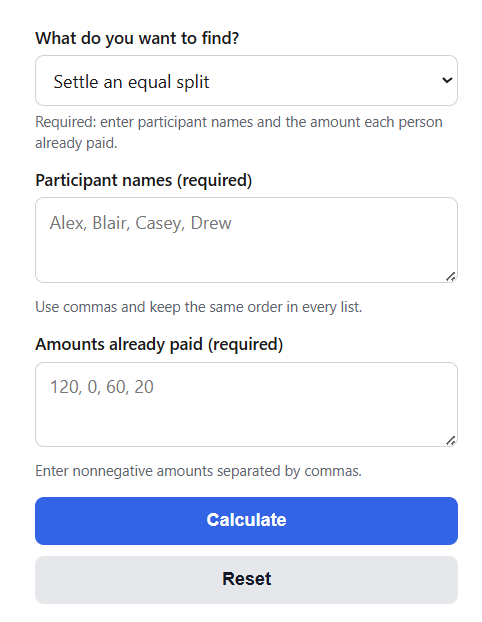
Use the Group Expense Settlement Calculator to divide shared costs, compare what each person paid, and create a short who-pays-whom reimbursement plan.
Group Expense Settlement Formula
The calculator first assigns each participant a fair share of the group expense, then compares that share with the amount the person already paid.
For an equal split, every weight is 1. For a weighted split, use:
Share_i = Total Expense * (Weight_i / Sum of Weights)
Each person’s net balance is:
Balance_i = Amount Paid_i - Share_i
Variables:
- Share_i is participant i’s fair share of the total expense
- Total Expense is the sum of all amounts already paid
- Weight_i is participant i’s split weight; equal splits use a weight of 1 for everyone
- Balance_i is positive when the person should receive money and negative when the person owes money
After the balances are calculated, the calculator matches people who owe money with people who should receive money. Each transfer reduces one debtor and one creditor until every balance is approximately zero. This produces a concise reimbursement plan without changing anyone’s fair share.
Group Expense Settlement Reference Table
This example shows an equal split for a $200 group expense. Each of four people is responsible for $50.
| Person | Already paid | Fair share | Net balance |
|---|---|---|---|
| Alex | $120.00 | $50.00 | Receives $70.00 |
| Blair | $0.00 | $50.00 | Owes $50.00 |
| Casey | $60.00 | $50.00 | Receives $10.00 |
| Drew | $20.00 | $50.00 | Owes $30.00 |
Example Problems
Example 1: Settle an equal group expense.
Alex, Blair, Casey, and Drew paid $120, $0, $60, and $20. The total is $200, so each fair share is $200 / 4 = $50.
One valid minimal settlement is Blair pays Alex $50, Drew pays Alex $20, and Drew pays Casey $10. After those transfers, every person has contributed exactly $50.
Example 2: Use weighted shares.
Three people share a $300 expense with weights 2, 1, and 1. The sum of the weights is 4.
Their fair shares are $300 × 2/4 = $150, $300 × 1/4 = $75, and $75. The calculator then compares those shares with what each person paid and creates the reimbursement transfers.
Frequently Asked Questions
What does a positive balance mean?
A positive balance means that person paid more than their fair share and should receive money. A negative balance means the person paid less than the fair share and must pay money into the settlement.
Does the calculator minimize the number of payments?
It sorts debtors and creditors by balance and matches the largest remaining balances first. That normally creates a very short payment list, although different payment lists can sometimes settle the same group with the same number of transfers.
When should I use a weighted split?
Use weights when equal shares are not appropriate. For example, two adults and two children might use weights of 1, 1, 0.5, and 0.5, or roommates can use agreed weights based on room size or usage.