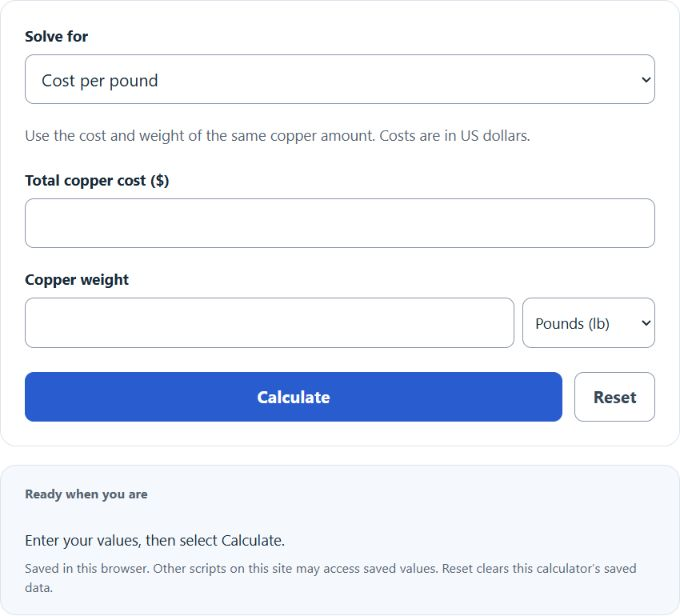
Calculate copper cost per pound, total cost, or total weight by selecting a solve mode and entering the known values, with weight in pounds, kilograms, or ounces.
- All Business Calculators
- Price Per Pound Calculator
- Cost Per Ounce Calculator
- Price Per kg Calculator
- Cost Per Pound of Steel Calculator
- Aluminum Cost Per Pound Calculator
- Steel Cost Per Ton Calculator
- Copper Price Calculator
- Cost Per Ton Calculator
Cost Per Pound of Copper Formula
The calculator uses total cost, total copper weight, and cost per pound. If the weight is entered in kilograms or ounces, it first converts the weight to pounds.
- CPP = cost per pound of copper, in dollars per pound
- TC = total cost of copper, in dollars
- W_lb = total weight of copper, converted to pounds
To calculate total cost, the formula is rearranged as:
To calculate total weight in pounds, the formula is rearranged as:
For unit conversion, the calculator uses:
- W = weight entered in the selected unit
- CF = conversion factor to pounds
- lb uses a conversion factor of 1
- kg uses the exact reciprocal of 0.45359237 (approximately 2.20462262)
- oz uses a conversion factor of 0.0625
Select Cost per pound, Total cost, or Total weight, enter the shown values, then select Calculate. The weight solve converts pounds to the selected result unit.
Copper Weight Conversion Reference
| Unit | Equivalent in Pounds | Use in the Calculator |
|---|---|---|
| 1 pound | 1 lb | Use when your copper weight is already in pounds. |
| 1 kilogram | Approximately 2.20462262 lb | Use for metric weights. |
| 1 ounce | 0.0625 lb | Use for small copper quantities. |
Common Copper Cost Checks
| What You Know | What You Can Find | Calculation |
|---|---|---|
| Total cost and total weight | Cost per pound | Divide total cost by pounds. |
| Cost per pound and total weight | Total cost | Multiply cost per pound by pounds. |
| Total cost and cost per pound | Total weight | Divide total cost by cost per pound. |
Example Problems
Example 1: Find cost per pound
You paid $96 for 24 pounds of copper.
The cost per pound is $4.00/lb.
Example 2: Find total cost with kilograms
You have 10 kg of copper, and the price is $3.75 per pound.
The total cost is $82.67.
FAQ
Why does the calculator convert kilograms and ounces to pounds?
The final rate is dollars per pound, so every weight must be expressed in pounds before the cost per pound can be calculated. Kilograms are divided by the exact factor 0.45359237 kg/lb, and avoirdupois ounces are divided by 16.
Does cost per pound mean the current market price of copper?
Not always. Cost per pound is the average price for the copper amount you entered. It may include scrap pricing, dealer pricing, shipping, handling, or other costs if those are included in your total cost.
Can the total weight be zero?
A positive weight is required to calculate cost per pound. A supplied price and zero weight give zero total cost. Zero total cost and a positive price give zero weight; zero price cannot determine a unique weight.