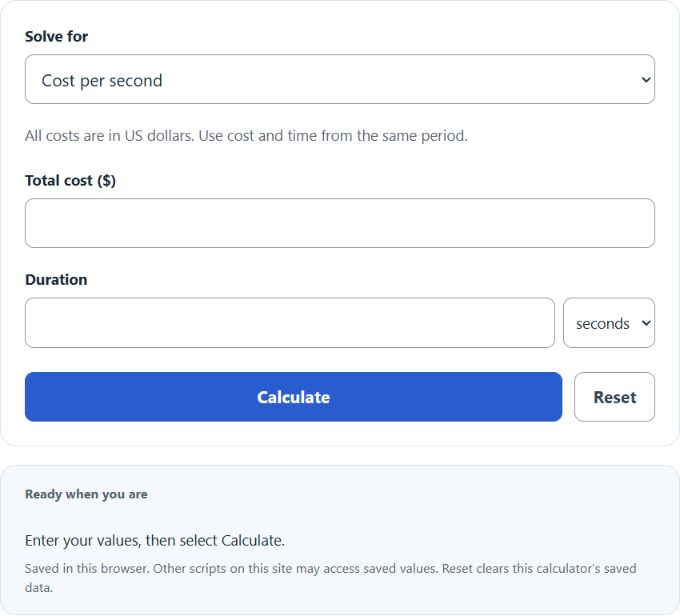
Calculate cost per second from total cost and time, find total cost or duration, and estimate salary-only meeting cost from salaries, participants, annual work hours, and time. All costs are in US dollars.
Cost Per Second Formula
The following equation is used to calculate the Cost Per Second.
- Where CPS is the cost per second ($/second)
- TC is the total cost ($)
- S is the total number of seconds, greater than zero when calculating a rate
To calculate the cost per second, divide the total cost by the number of seconds. One minute is 60 seconds and one hour is 3,600 seconds. Total cost equals rate per second multiplied by seconds; duration equals total cost divided by a positive rate per second.
The meeting estimate divides average annual salary by annual work hours, multiplies by participants, then scales by meeting duration. The editable 2,080-hour default assumes 52 weeks of 40 hours; it is not a universal payroll divisor. The estimate excludes benefits, overhead and other costs.
What is a Cost Per Second?
Definition:
Cost per second refers to the average cost incurred for every second of usage or time. It provides a high-resolution view of expenses and is especially useful for comparing rates or evaluating time-sensitive costs.
How to Calculate Cost Per Second?
Example Problem:
The following example outlines the steps and information needed to calculate the Cost Per Second.
First, determine the total number of seconds. In this example, someone used a service for 3600 seconds (1 hour).
Next, determine the total cost for that period. The service cost $72.00.
Finally, calculate the cost per second using the formula above:
CPS = TC / S
CPS = $72 / 3600
CPS = $.02 / second
FAQ
When should I use cost per second?
Cost per second is most valuable when you need precise cost details for time-bound activities, like measuring short usage intervals or comparing services that charge on a per-second basis.
How does cost per second help with budgeting?
Cost per second gives a granular look at expenses, which can be helpful when deciding how to allocate resources or evaluating whether certain time-based costs are justified.
Is it necessary to measure costs down to the second?
While not always necessary, measuring costs by the second can be beneficial if exact usage times matter for your operations or billing structure. This approach can highlight small but frequent expenses that may go unnoticed with broader time frames.