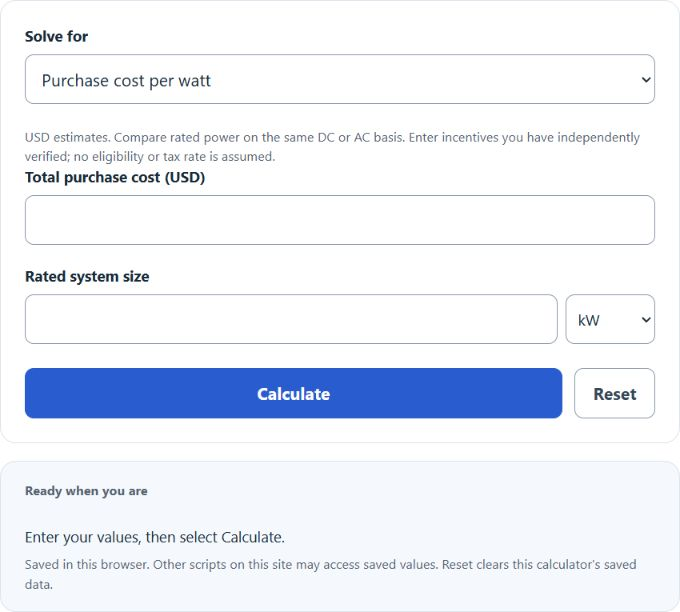
Calculate purchase or solar cost per watt, reverse a total budget, apply incentives, convert W/kW/MW, or estimate electricity running cost.
Related Calculators
Cost Per Watt Formula
The calculator provides purchase price per watt, total cost from a rate, solar net price and electricity running cost.
Price per watt:
Solar quote with incentives:
Running electricity cost:
- Total Cost: purchase price in dollars.
- Watts: rated power, converted from W, kW, or MW.
- Gross Cost: solar quote before incentives.
- Tax Credit %: percentage incentive entered only after verifying eligibility. The U.S. residential clean energy credit is not available for property placed in service after December31,2025; see IRS guidance.
- Rebate: fixed dollar incentive applied after the percentage credit.
- System Watts: the entered rated system size, using the same AC or DC basis for comparisons.
- Hours per Day: average daily run time, capped at 24.
- Rate: electricity price in dollars per kilowatt-hour.
Choose purchase cost per watt, total cost from a rate, solar net cost or electricity running cost. The solar model subtracts a verified percentage incentive and fixed rebate; it does not rate quote quality. Running cost uses average power, hours and a single electricity rate.
Reference Tables
These illustrative price and power examples are not market quotes or universal appliance ratings.
| Illustrative Solar PPW (gross) | Interpretation |
|---|---|
| Under $3.00/W | Compare equipment, rated-power basis and included work. |
| $3.00 to $4.50/W | Illustrative price band; no market classification is inferred. |
| $4.50 to $5.50/W | Scope and location may differ; compare itemized work. |
| Over $5.50/W | No quality rating follows from price per watt alone. |
| Appliance | Watts | Cost at 4 hrs/day, $0.17/kWh |
|---|---|---|
| LED bulb | 9 | $0.19/month |
| Incandescent bulb | 75 | $1.55/month |
| Laptop | 150 | $3.10/month |
| Microwave | 1,000 | $20.70/month |
| Space heater | 1,500 | $31.05/month |
| Central AC | 3,500 | $72.44/month |
| EV charger | 7,200 | $149.02/month |
Worked Examples
Example 1: Solar quote. A 6 kW system is quoted at $19,800 gross. For this hypothetical arithmetic example only, assume a verified30% incentive and an additional eligible$500 rebate. This is not a current federal-credit eligibility example.
- Gross PPW = 19,800 / 6,000 = $3.30/W
- Net cost = 19,800 × 0.70 − 500 = $13,360
- Net PPW = 13,360 / 6,000 = $2.23/W
Example 2: Running cost. A 1,500 W space heater runs 5 hours per day at $0.17/kWh.
- Energy = 1,500 × 5 / 1,000 = 7.5 kWh/day
- Daily cost = 7.5 × 0.17 = $1.28
- Monthly cost ≈ $38.81
FAQ
Should I compare quotes using gross or net price per watt?
Use gross PPW to compare installers on equal footing. Incentives vary by location and tax situation, so net PPW reflects your wallet but not the installer’s pricing.
Does price per watt include the inverter and installation?
For solar, gross system cost should be the full turnkey price: panels, inverter, racking, wiring, permits, and labor. If a quote excludes any of these, the PPW will look artificially low.
Why is monthly cost calculated with 30.4375 days?
That is the average days per month in a365.25-day year (365.25 /12). It avoids the swing between 28-day and 31-day months.
What electricity rate should I use?
Use applicable variable supply and delivery charges from your own bill. No default tariff or current national average is assumed; fixed charges require separate treatment.
Cost Per Watt Formula
The basic cost per watt formula divides the total cost by the total watts of power or system capacity.
- Cost Per Watt is the price for each watt of capacity, usually shown as dollars per watt.
- Total Cost is the full purchase price or system price.
- Watts is the total power or system size in watts.
For solar quotes, the calculator can compare gross price per watt and net price per watt after a percentage incentive and any fixed rebate.
- Gross System Cost is the quoted price before incentives or rebates.
- System Watts is the solar system size in watts.
- Incentive Percent is the tax credit or percentage discount.
- Fixed Rebate is a dollar amount subtracted after the percentage incentive.
- Net Cost is the remaining cost after incentives are applied.
For a panel-based quote, first multiply panel count by rated watts per panel and enter the resulting known system size.
- Number Of Panels is the count of solar panels in the system.
- Watts Per Panel is the rated wattage of one panel.
For running electricity cost, the calculator converts watts to kilowatt-hours and multiplies by your electricity rate.
- Watts is the appliance power draw.
- Hours Per Day is daily use time.
- Daily kWh is daily energy use in kilowatt-hours.
- Electricity Price is your utility rate in dollars per kWh.
The price per watt tab is best for a direct equipment or system price. The solar quote tab is best when incentives or panel counts matter. The running cost tab is for estimating electricity use over time, not purchase price per watt.
Interpreting Price Per Watt Examples
Cost per watt depends on what you are measuring. A finished installed system usually costs more per watt than the panels alone.
| Item or system | Common result | What it usually means |
|---|---|---|
| Solar panel only | Often under installed system pricing | Does not include inverter, mounting, labor, design, permitting, or markup. |
| Residential solar quote | Example band: $3.00 to $4.50 per watt; not a current market benchmark | Compare equipment, roof work, batteries, financing, and warranty terms before judging the quote. |
| Low solar quote | Example below$3.00 per watt; not automatically a better quote | Check included work, equipment and whether the price is before or after incentives. |
| High solar quote | Example above$4.50 per watt; scope may differ | May include adders such as batteries, complex roof work, electrical upgrades, or higher financing costs. |
Common Appliance Running Cost Inputs
Use the running cost mode when you want to estimate the electricity cost of using an appliance.
| Appliance | Illustrative wattage | Notes |
|---|---|---|
| LED bulb | 9 W | Low power use, but total cost depends on hours used. |
| Laptop | 150 W | Actual draw may be lower during light use. |
| Microwave | 1000 W | High wattage, but usually used for short periods. |
| Space heater | 1500 W | Can add noticeable cost if used for many hours per day. |
| EV charger | 7200 W | Cost depends heavily on charge time and electricity rate. |
Example Calculations
Example 1: Solar price per watt
You have a solar quote for $19,250 and the system size is 5.5 kW.
First convert kilowatts to watts:
Then divide the total cost by watts:
The result is $3.50 per watt.
Example 2: Running cost
You use a 1500 W space heater for 4 hours per day, and electricity costs $0.17 per kWh.
The estimated cost is $1.02 per day, or about $31.05 per month.
FAQ
Is cost per watt the same as cost per kilowatt-hour?
No. Cost per watt measures purchase price or installed capacity. For example, a solar system quote can be compared in dollars per watt. Cost per kilowatt-hour measures electricity usage or energy cost over time. Utility bills usually charge by kilowatt-hour, not by watt.
Should solar price per watt be calculated before or after incentives?
Both numbers can be useful. Gross price per watt shows the quote before incentives and is often better for comparing installer pricing. Net price per watt shows your estimated cost after tax credits or rebates. If you compare quotes, make sure every quote is being compared on the same basis.
Why does the calculator convert kW to watts?
Cost per watt uses watts in the denominator. Since many solar systems are listed in kilowatts, the calculator converts kW to W by multiplying by 1000. For example, 6.2 kW is 6200 W.