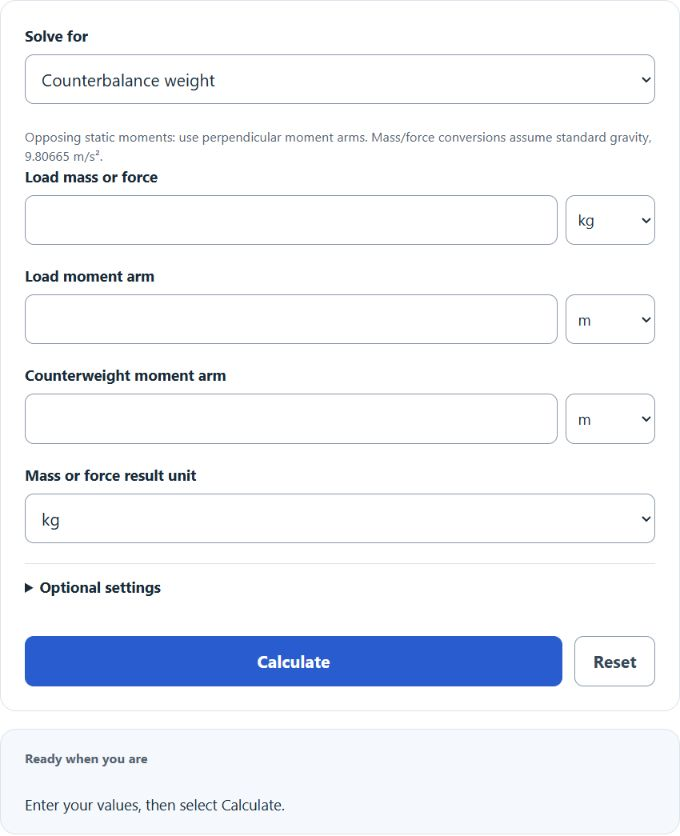
Calculate counterbalance weight or fulcrum distance to balance a load, or solve for load weight and distance in kilograms, pounds, newtons, meters, feet, or inches.
- All Construction Calculators
- Torque Calculator
- Torque to Force Calculator
- Crane Tipping Load Calculator
Counterbalance Weight Formula
The following equation is used to calculate the weight of a counterbalance.
- Where CBW is the counterbalance weight
- Mo is the mass of the object
- Do is the distance from object to the fulcrum
- Db is the distance from the counterbalance to the fulcrum
For ideal balance, multiply the load mass by its perpendicular moment arm and divide by the counterweight’s perpendicular moment arm. Use consistent mass units under the same gravity, or use forces consistently. The optional counter-moment multiplier specifies a ratio above ideal balance; it does not itself establish equilibrium or certify safety.
What is a Counterbalance Weight?
Definition:
A counterbalance is a weight that, when placed at a certain distance, produces the same torque as another object at a different distance from the fulcrum.
How to Calculate Counterbalance Weight?
Example Problem:
The following example outlines the steps and information needed to calculate the Counterbalance Weight.
First, determine the mass of the object. In this example, the mass of the object is 10 lbs.
Next, determine the distance from the object to the fulcrum. In this case, this is 5 ft.
Next, determine the distance from the counterbalance to the fulcrum. For this problem, this is 3ft.
Finally, calculate the counterbalance weight using the formula above:
CBW = Mo*Do/Db
CBW = 5*10/3
CBW = 16.67 lbs