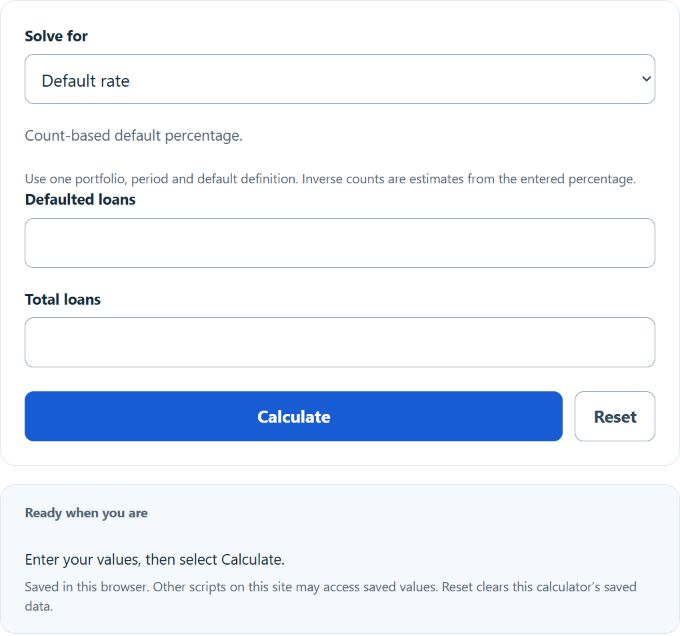
Calculate credit default rate, number of defaults, or total loans from any two values to find the missing loan risk variable in banking.
Related Calculators
- Cash Coverage Ratio Calculator
- Cost of Funds Calculator
- Invoice Late Fee Calculator
- Constant/Conditional Prepayment Rate (CPR) Calculator
- All Business Calculators
Credit Default Rate Formula
The credit default rate is the percentage of loans in a portfolio that have defaulted. This calculator uses the count of defaulted loans, not the dollar value of those loans.
- CDR = Credit default rate, as a percentage
- D = Number of defaults
- L = Total number of loans
If you select Default rate, the calculator uses the number of defaults and total number of loans:
If you select Implied defaults, the calculator rearranges the formula:
If you select Implied total loans, the calculator solves for the loan count:
Select the quantity to solve for and enter the two required values. Observed counts must be whole numbers, defaults cannot exceed the portfolio, and the rate must be between 0% and 100%. Inverse results show the unrounded implied count and a separate nearest whole count; a rounded percentage may not imply an exact observed count.
Credit Default Rate Reference Ranges
These are illustrative percentage bands, not validated risk benchmarks. Actual meaning depends on the measurement period, default definition, loan type, portfolio age and other conditions.
| Credit Default Rate | Illustrative Band |
|---|---|
| 0% to 1% | 0 to 1 defaults per 100 loans |
| 1% to 3% | 1 to 3 defaults per 100 loans |
| 3% to 7% | 3 to 7 defaults per 100 loans |
| Above 7% | More than 7 defaults per 100 loans |
Default Rate Inputs by Loan Portfolio Type
| Input | What to Count | Common Issue |
|---|---|---|
| Number of Defaults | Loans that meet your default definition | Mixing late payments with formal defaults |
| Total Number of Loans | All loans in the measured portfolio or period | Using only active loans and excluding charged-off loans |
| Credit Default Rate | Defaults as a percentage of total loans | Comparing portfolios with different default definitions |
Example Calculations
Example 1: Calculate the credit default rate
You have 18 defaulted loans out of 600 total loans.
The credit default rate is 3.00%.
Example 2: Calculate the number of defaults
You have a credit default rate of 4.5% across 2,000 loans.
The estimated number of defaults is 90 loans.
FAQ
What counts as a default?
A default is usually a loan that has failed to meet its required payment terms for a defined period or has been charged off according to the lender’s rules. The exact definition can vary. For consistent results, use the same default definition for every calculation.
Is credit default rate the same as loss rate?
No. Credit default rate measures how many loans defaulted. Loss rate measures how much money was lost. A portfolio can have a high default rate but a lower loss rate if recoveries are strong, collateral values are high, or defaulted balances are small.
Can the total number of loans be zero?
No. The total number of loans cannot be zero when calculating a default rate because the formula divides by the total loan count. A zero denominator makes the rate undefined.