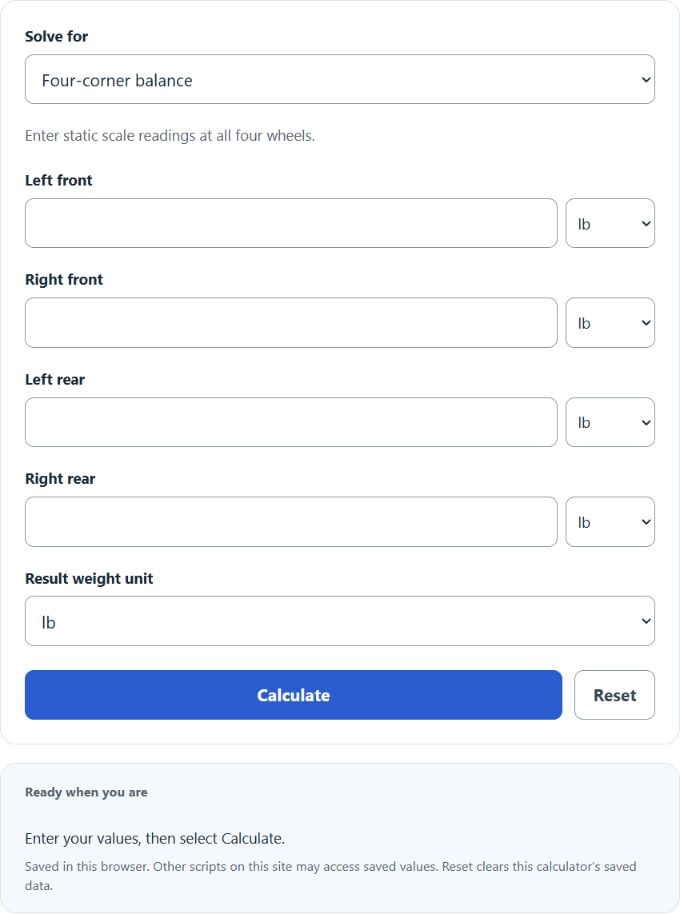
Calculate vehicle cross weight percentage from four corner readings, plus left/front balance, diagonal totals, ideal target-cross transfers, and changes to one corner reading. The transfer and what-if modes are mathematical comparisons, not predictions of suspension or ballast response.
- All Automotive Calculators
- All Weight Calculators
- GVWR (Gross Vehicle Weight Rating) Calculator
- Motorcycle Weight Limit Calculator
- Net Mass Calculator
Cross Weight Formula
The following formula is used to calculate the Cross Weight.
Variables:
- CW is the Cross Weight (%)
- LF is the left-front weight (lb or kg)
- RF is the right-front weight (lb or kg)
- LR is the left-rear weight (lb or kg)
- RR is the right-rear weight (lb or kg)
- TW is the total vehicle weight (same unit); if using corner weights, TW = LF + RF + LR + RR
To calculate the cross weight, sum the left-rear and right-front weights, divide by the total vehicle weight, then multiply by 100.
How to Calculate Cross Weight?
The following two example problems outline the steps and information needed to calculate the Cross Weight.
Example Problem #1
- First, determine the left-rear weight (lbs).
- The left-rear weight (lbs) is measured to be 500.
- Next, determine the right-front weight (lbs).
- The right-front weight (lbs) is measured to be 600.
- Next, determine the total car weight (lbs).
- The total car weight (lbs) is found to be 2000.
- Finally, calculate the Cross Weight using the formula above:
CW = (LR + RF) / TW * 100
The values provided above are inserted into the equation below and computed.
CW = (500 + 600) / 2000 * 100 = 55.00 (%)
Example Problem #2
The variables required for this problem are provided below:
left-rear weight (lbs) = 500
right-front weight (lbs) = 400
total car weight (lbs) = 3000
Test your knowledge and check your answer with the calculator.
CW = (LR + RF) / TW * 100 = (%)