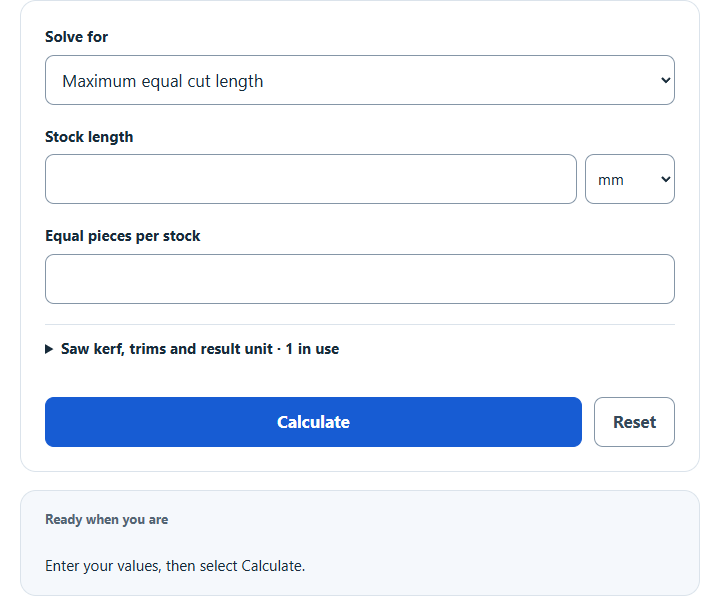
Calculate cut length for equal pieces, how many pieces fit in a stock length or how many stock lengths you need, with optional saw kerf and end trims.
- All Construction Calculators
- All Length Calculators
- Angle Cut Calculator
- Cutting Time Calculator
- Laser Cutting Time Calculator
- Cut Sheet Calculator
Calculator Functions
| Function | What it does | What it requires |
|---|---|---|
| Maximum equal cut length | Finds the longest equal piece when one stock length is cut into a set number of pieces | Requires the stock length and the number of equal pieces |
| Pieces from one stock length | Finds how many whole pieces of a chosen length come out of one stock length | Requires the stock length and the finished-piece length |
| Stock lengths needed | Finds how many stock lengths cover a total number of finished pieces | Requires the stock length, the finished-piece length and the total pieces needed |
Saw kerf, start trim and end trim are optional in every function, and a blank means zero. Lengths are entered in mm, cm, m, in or ft, and the answer unit is chosen separately. Each result also lists the usable length, total kerf loss, trim reserved, unused remainder and material yield.
Cut Length Formulas
| CL | Length of each finished piece |
| L | Stock length |
| T | Start trim plus end trim |
| P | Number of equal pieces |
| K | Saw kerf, the width the blade removes, counted once for every piece |
Maximum equal cut length
With no kerf or trim, the stock length is simply divided by the piece count: a 4 ft board cut into 10 equal pieces gives 48 in ÷ 10 = 4.8 in each. With a blade, each piece loses one kerf: a 36 in piece cut into 12 with a 1/16 in blade gives 36 ÷ 12 − 0.0625 = 2.9375 in.
Pieces from one stock length
N is rounded down to whole pieces. A 5.3 m bar cut into 328 mm pieces gives floor(5,300 ÷ 328) = 16 pieces with 52 mm left over. A 20 in bar cut into 1.5 in billets with 1/8 in allowed per saw cut gives floor(20 ÷ 1.625) = 12.
Stock lengths needed
Q is the total number of finished pieces and S is rounded up to whole stock lengths. For 50 pieces of 600 mm from 2,400 mm lengths with a 3 mm kerf, N = floor(2,400 ÷ 603) = 3 and S = ceiling(50 ÷ 3) = 17, with 2 pieces cut from the last length.
Material yield is the finished material divided by the purchased length, times 100. Inch and foot entries are converted with 1 in = 25.4 mm and 1 ft = 304.8 mm, both exact [1].
Limits of This Estimate
- One kerf is charged for every finished piece, including the last. A plan that uses the factory end and makes one cut fewer leaves slightly more material than shown.
- No allowance is added for defects, clamping, measuring error or machine tolerance beyond the trims entered.
- All pieces are the same length. Mixed lengths cut from the same stock need a cutting plan the calculator does not make.
Sources
- NIST, Guide to the SI (Special Publication 811), Appendix B.8: inch and foot in SI units