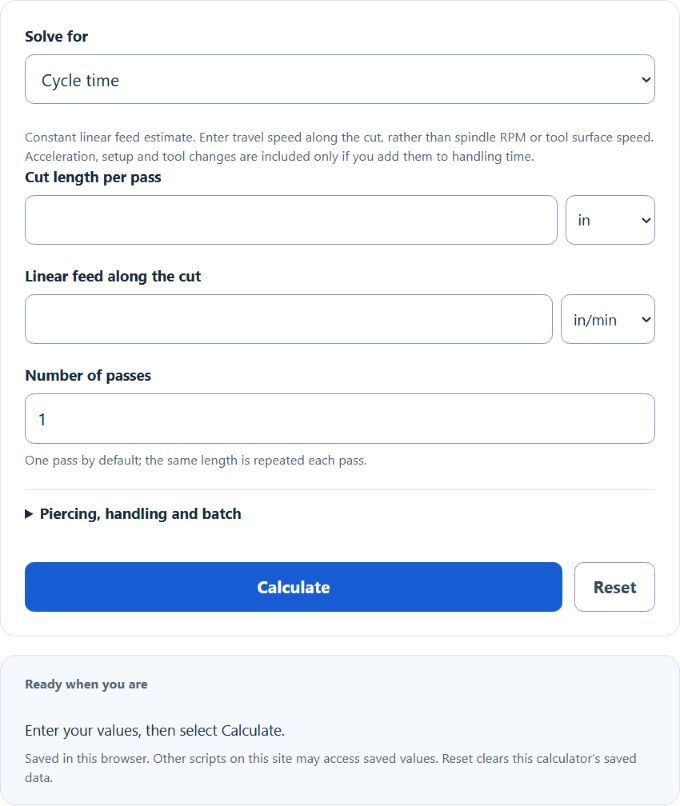
Calculate cutting time from cut length and feed rate times the number of passes, with optional pierce and handling time, parts per hour and batch time.
- All Construction Calculators
- Drill SFM Calculator
- Surface Speed (SFM) Calculator
- Chip Load Calculator
- Lathe RPM Calculator
- Laser Cutting Time Calculator
Calculator Functions
| Function | What it does | What it requires |
|---|---|---|
| Cycle time | Finds the total time per part from cutting, piercing and handling | Requires the cut length per pass, the linear feed along the cut and the number of passes |
| Cut length for a target cycle | Finds the longest cut per pass that fits a target cycle time | Requires the target total cycle, the linear feed and the number of passes |
| Linear feed for a target cycle | Finds the feed needed to finish within a target cycle time | Requires the target total cycle, the cut length per pass and the number of passes |
| Turning time (feed per revolution) | Finds the cutting time on a lathe running at constant spindle speed | Requires the cut length per pass, the feed per revolution, the spindle speed in RPM and the number of passes |
Length can be entered in inches, millimetres or metres, and feed in in/min, mm/min or m/min. Optional settings add pierces per part, seconds per pierce, handling or rapid time per part and a batch quantity. Every result also lists parts per hour and the batch duration.
Cutting Time Formulas
| T | Cutting time (min) |
| L | Cut length per pass |
| P | Number of passes over the same length |
| F | Linear feed along the cut, in the same length unit per minute. It is not spindle RPM or tool surface speed |
Cycle time
Tc is the total cycle per part, tp is the pierces per part times the seconds per pierce, and th is the handling or rapid time per part. A 6 in cut at 2 in/min takes 6 ÷ 2 = 3 minutes in one pass. With 2 pierces of 5 seconds each and 20 seconds of handling, the cycle is 180 + 10 + 20 = 210 seconds, or 3.5 minutes, which is 17.14 parts per hour. Pierces are counted once per part, not once per pass.
Cut length for a target cycle
tf is the fixed time: piercing plus handling. A 5 minute target with 30 seconds of handling leaves 4.5 minutes for cutting, so at 2 in/min in one pass the cut can be 9 in long. The target must be longer than the fixed time.
Linear feed for a target cycle
A 12 in cut that has to finish in a 3 minute cycle with no fixed time needs 12 ÷ 3 = 4 in/min. The answer is a timing requirement, not a recommended setting for the machine or the material.
Turning time (feed per revolution)
f is the feed per revolution and N is the spindle speed in RPM, so f × N is the linear feed [1]. A 100 mm cut at 0.2 mm/rev and 500 RPM moves at 100 mm/min and takes 1 minute per pass, or 2 minutes (120 seconds) for two passes. This is engaged cutting time; handling is added separately for the total cycle. Surface speed is a different quantity: the Surface Speed (SFM) Calculator relates it to cutting diameter and RPM.
Limits of This Estimate
- The feed is assumed constant for the whole cut. Acceleration, corners and lead-ins make real cuts take longer.
- Setup, tool changes, approach and retract are left out unless their time is entered as handling.
- Batch duration is the cycle time multiplied by the quantity, with no setup between parts or batches.
- The timing formulas do not choose feeds or speeds. Tool, material and machine limits decide what is safe to run.
Sources
- Mitsubishi Materials, Formula for Turning: linear feed from feed per revolution and spindle speed, and turning cutting time