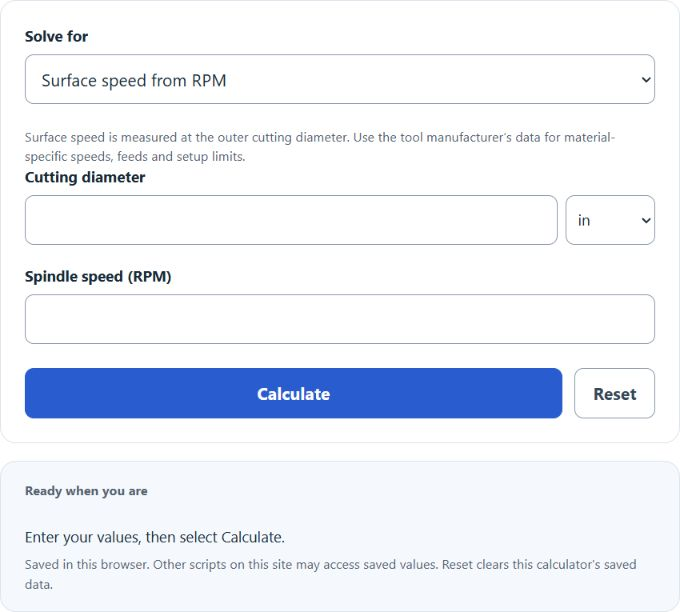
Calculate drill surface feet per minute from diameter and RPM, or reverse-solve spindle speed from SFM or meters per minute with unit conversion.
- All Construction Calculators
- Surface Speed (SFM) Calculator
- Spindle Speed Calculator
- Countersink Depth Calculator
- Drill Tip Length Calculator
Drill SFM Formula
The calculator uses one of two equations depending on the selected solve target.
Surface speed from RPM:
RPM from a target surface speed:
- SFM = surface feet per minute at the drill’s outer edge
- D = drill diameter in inches
- RPM = spindle speed in revolutions per minute
If diameter is entered in millimeters, divide by exactly25.4 for inches. For m/min to ft/min, divide by exactly0.3048. The12 in the SFM formula converts inches per minute to feet per minute. This calculator does not assign a material-specific cutting speed or a universal HSS/cobalt/carbide multiplier.
Selecting a Target Surface Speed
The geometry equations convert a chosen speed; they do not determine which speed is appropriate for a machining operation.
Use the exact tool manufacturer’s cutting-data chart for the work material, tool grade, coating, diameter, hole depth and coolant conditions. A generic material name and fixed tool multiplier cannot establish a suitable cutting speed.
Geometric RPM at a hypothetical100 SFM by drill size (not cutting recommendations):
| Diameter | RPM at 100 SFM |
|---|---|
| 1/8 in (3.18 mm) | 3056 |
| 1/4 in (6.35 mm) | 1528 |
| 3/8 in (9.53 mm) | 1019 |
| 1/2 in (12.7 mm) | 764 |
| 3/4 in (19.05 mm) | 509 |
| 1 in (25.4 mm) | 382 |
Example and FAQ
Example: For a0.5in diameter and a hypothetical100SFM target, RPM =1200/(π×0.5) ≈763.943727. The nearest whole number is764RPM, giving about100.007366SFM. This is an arithmetic example, not a material or machine-setting recommendation.
What is SFM? Surface feet per minute. It is the linear speed of the cutting edge at the outer diameter of the drill.
Why does SFM matter more than RPM? SFM is set by the material and the tool. A small drill needs high RPM to hit the same SFM that a large drill reaches at low RPM.
Should coolant change the target? Follow the tool manufacturer’s guidance for the exact coolant method and operation. This calculator does not infer a safe speed increase or reduction.
What if my machine cannot reach the calculated RPM? Choose a setup within the machine and tool manufacturer’s permitted operating range. Do not infer that the highest available RPM or a generic feed reduction is suitable. Consult the tooling supplier for an alternative setup.