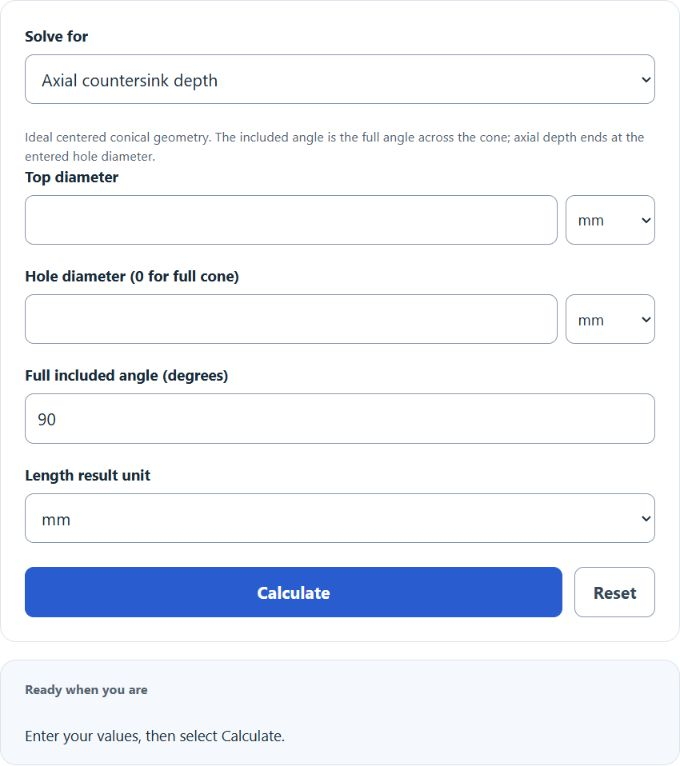
Calculate theoretical countersink Z-depth, top diameter, hole diameter, or included angle in millimeters, inches, or centimeters for a centered conical cut.
Related Calculators
- Plunge Rate Calculator
- Chip Per Tooth Calculator
- Hole Volume Calculator
- Bolt Pretension Calculator
- All Construction Calculators
Countersink Depth Formula
- h = countersink depth measured from the surface to the bottom of the cone
- D = surface countersink diameter (the wide opening at the top)
- d = existing hole or pilot diameter (use 0 for a full cone into solid stock)
- A = included angle of the countersink tool, in degrees
Rearranged forms used by the other modes:
For flat-head screws, D is the screw head diameter and d is the clearance hole, so the depth becomes:
The formula assumes a sharp, symmetrical conical tool and a flat workpiece surface. Tip flats or radii, datum choice, tolerances and actual tool geometry can change measured depth; use the tool drawing rather than a universal numerical correction.
Common Angles and Illustrative Screw Head Sizes
These examples are not a substitute for the applicable fastener/tool drawing. Head and clearance dimensions vary by standard and product.
Match the included angle in the calculator to the screw or fastener standard you are using.
| Angle | Typical use |
|---|---|
| 60° | Lathe centers, deburring |
| 82° | Imperial flat-head machine and wood screws |
| 90° | Metric flat-head screws, general chamfering |
| 100° | Aerospace flat-head screws (NAS, MS) |
| 120° | Sheet metal rivets, thin-stock countersinks |
| Screw | Head Ø | Normal clearance | Depth at standard angle |
|---|---|---|---|
| #6 (82°) | 0.279 in | 0.150 in | 0.075 in |
| #8 (82°) | 0.332 in | 0.177 in | 0.089 in |
| #10 (82°) | 0.385 in | 0.201 in | 0.105 in |
| M3 (90°) | 6.0 mm | 3.4 mm | 1.3 mm |
| M5 (90°) | 10.0 mm | 5.5 mm | 2.3 mm |
| M6 (90°) | 12.0 mm | 6.6 mm | 2.7 mm |
Worked Example and Notes
Example. You need an 82° countersink for a #8 flat-head screw with a normal clearance hole of 0.177 in. Head diameter is 0.332 in.
h = (0.332 − 0.177) / [2 × tan(41°)] = 0.155 / 1.7391 ≈ 0.089 in.
This is the ideal geometric depth for the stated diameters and angle. Actual flushness depends on the fastener and tool profiles, tolerances and required drawing allowances.
Should the head sit flush, proud, or sub-flush? Use the flushness and allowance specified for the joint and finish. A proud head may also reflect mismatched angles, dimensions or tool geometry.
What if the hole is not drilled yet? Enter 0 for the hole diameter to model the theoretical full cone. For an existing pilot hole, use its actual diameter to measure axial depth to the hole-diameter intersection.
Why does my measured depth differ slightly? Most countersink cutters have a small chamfered or radiused tip rather than a true sharp point. A universal difference cannot be assumed; compare the actual tool and fastener drawings, datum and measurement method.