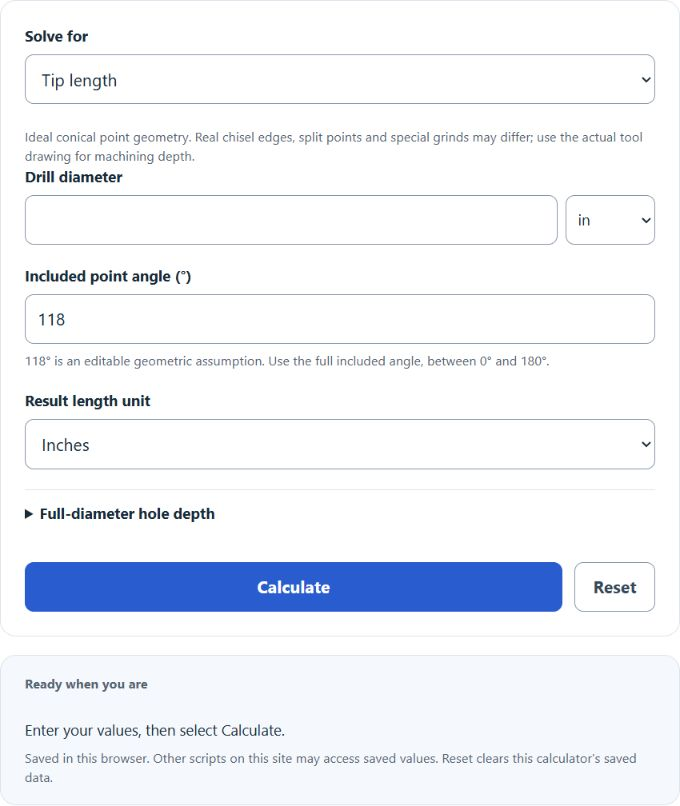
Calculate drill tip length, tip angle, or drill diameter from any two inputs, and find required drill travel for a target hole depth.
- All Construction Calculators
- All Length Calculators
- Drill SFM Calculator
- Rivet Length Calculator
- Bolt Length Calculator
Calculator Functions
| Function | What it does | What it requires |
|---|---|---|
| Tip length | Finds the axial length of the drill point, measured from the tip to where the full diameter begins | Requires the drill diameter and the included point angle |
| Drill diameter | Finds the drill diameter that gives a known point length at a known point angle | Requires the axial tip length and the included point angle |
| Included point angle | Finds the full point angle of a drill from its measured diameter and point length | Requires the drill diameter and the axial tip length |
Drill diameter and axial tip length are each entered in inches or millimetres, and the result length unit is set separately. The point angle starts at 118°, with presets for 135°, 90°, 130° and 60°. An optional full-diameter hole depth adds the tip travel from the entry surface. Every result also lists the tip length at the same diameter for 60°, 90°, 118°, 120°, 130°, 135° and 140° points.
Drill Tip Length Formulas
| L | Axial tip length, from the apex of the point to the full diameter (in or mm) |
| D | Drill diameter, in the same unit as L |
| A | Full included point angle in degrees, greater than 0° and less than 180° |
The drill point is treated as a symmetric cone, so half the diameter and the tip length form a right triangle with half the point angle at the tip. Haas Automation gives the same relationship as shop multipliers of the diameter: 0.3 for a 118° point, 0.207 for 135° and 0.182 for 140° [1].
Tip length
The main formula applies directly. For a fixed point angle the tip length is a constant share of the diameter, so a 0.5 in drill with a 118° point has a tip length of 0.5 × 0.3004 = 0.1502 in.
| Point angle | Tip length ÷ diameter | Tip length of a 1/2 in drill |
|---|---|---|
| 60° | 0.8660 | 0.4330 in |
| 90° | 0.5000 | 0.2500 in |
| 118° | 0.3004 | 0.1502 in |
| 120° | 0.2887 | 0.1443 in |
| 130° | 0.2332 | 0.1166 in |
| 135° | 0.2071 | 0.1036 in |
| 140° | 0.1820 | 0.0910 in |
Drill diameter
This is the main formula solved for the diameter. A point 3 mm long ground at 118° belongs to a drill of 2 × 3 × tan(59°) = 9.9857 mm.
Included point angle
The inverse tangent returns half the point angle, which is doubled to give the full included angle. A 12 mm drill whose point measures 2.4853 mm has a 135° point.
Drill depth to the tip
T is the ideal tip travel from the entry surface and H is the required full-diameter depth, the optional input. A drawing normally dimensions a hole to the end of its full diameter, so the point length is added to reach the programmed depth [1]. A 12 mm drill with a 135° point cutting 25 mm of full-diameter hole travels 25 + 2.4853 = 27.4853 mm.
Limits of This Estimate
- The result is for an ideal symmetric conical point. Chisel edges, split points, web thinning, flat-bottom drills and special grinds make the real point shorter or longer than the cone.
- The angle is the full included angle. Entering the half angle, such as 59° for a 118° drill, gives a tip length about three times too long.
- Tip travel adds only the point allowance. It does not set breakthrough clearance, stock clearance, drill reach or a machine setting, and the actual tool geometry should be checked before cutting.
Sources
- Haas Automation UK, Working out Drill Depth: point length multipliers for 118°, 135° and 140° drills, and adding the point length to the full-diameter depth