Calculate rivet length from grip and shank diameter with the 1.5 × diameter rule, estimate rivet diameter from sheet thickness, or check blind rivet grip.
- All Construction Calculators
- All Length Calculators
- Bolt Length Calculator
- Bolt Area Calculator
- Riveting Force Calculator
- Pin Shear Calculator
Calculator Functions
| Function | What it does | What it requires |
|---|---|---|
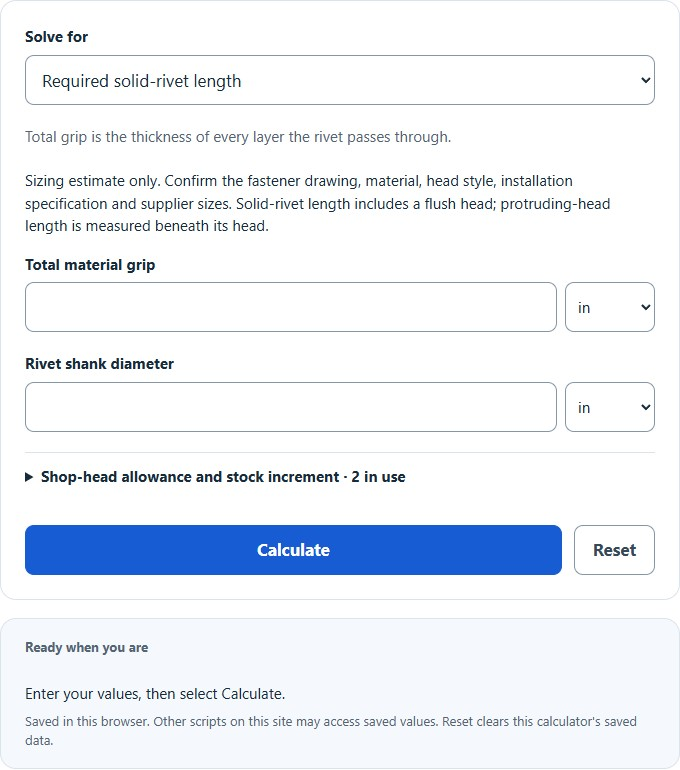
| Required solid-rivet length | Finds the solid rivet length for a material stack and rounds it up to a stock length | Requires the total material grip and the rivet shank diameter |
| Maximum solid-rivet grip | Finds the thickest material stack that a solid rivet of a known length can join | Requires the available rivet length and the rivet shank diameter |
| Check blind-rivet grip range | Checks whether a material stack falls inside the grip range of a blind (pop) rivet | Requires the total material grip and the minimum and maximum grip stated by the rivet maker |
| Rivet diameter from sheet thickness | Estimates a rivet diameter from the thickest sheet and shows the next standard size | Requires the thickness of the thickest sheet |
Lengths can be entered in in, mm, cm, m or ft, as decimals or as fractions such as 5/32. The two solid-rivet functions have an optional formation allowance, which starts at 1.5 diameters. Required solid-rivet length also has an available length increment, which starts at 1/16 in.
Rivet Length Formulas
| L | Solid rivet length |
| G | Total material grip, the combined thickness of every layer the rivet passes through |
| D | Rivet shank diameter |
| 1.5 | Formation allowance in diameters. This much shank must stick out of the material to be driven into the shop head, and it is normally about 1.5 × D [1] |
Required solid-rivet length
ceiling(L ÷ step) × step
The main formula gives the theoretical length, which is then rounded up to the next multiple of the length increment. Two 0.050 in sheets make a 0.1 in grip. With a 5/32 in rivet the theoretical length is 0.1 + 1.5 × 0.15625 = 0.3344 in, and the next 1/16 in length is 0.375 in, or 3/8 in. In metric, a 3 mm grip with a 3.2 mm rivet needs 3 + 4.8 = 7.8 mm, which rounds up to 8 mm on 0.5 mm steps. A length that already lands on a step is not rounded: a 0.125 in grip with a 1/8 in rivet needs exactly 0.3125 in, or 5/16 in.
Maximum solid-rivet grip
A 1/2 in long rivet with a 1/8 in shank leaves 0.5 − 1.5 × 0.125 = 0.3125 in for material. If the allowance uses up the whole rivet, the calculator asks for a longer rivet.
Check blind-rivet grip range
Blind rivets, also sold as pop rivets, are not sized with the 1.5 × D allowance. Each one is made for a grip range, and the material stack has to fall inside it. A 4 mm stack is within a 3.2 to 4.8 mm grip range, with 0.8 mm to spare at each end. A 5 mm stack is outside it by 0.2 mm, so the next longer rivet is needed. Both ends of the range count as inside.
Rivet diameter from sheet thickness
T is the thickness of the thickest sheet in the joint. The rule of thumb is a rivet diameter of at least three times that thickness [1]. A 0.050 in sheet gives 0.15 in, and the next standard size is 5/32 in. A 0.032 in sheet gives 0.096 in, and the next standard size is 1/8 in. The sizes checked are 1/16, 3/32, 1/8, 5/32, 3/16, 1/4, 5/16 and 3/8 in.
Limits of This Estimate
- This is a sizing estimate only. Confirm the fastener drawing, material, head style, installation specification and supplier sizes. On aircraft, the drawing or structural repair manual governs.
- The 1.5 diameter allowance is a common figure, not a universal one. Finished shop heads are judged against the installation standard, which sets their own minimum diameter and height [1]. A rivet that is too long can bend over when it is driven.
- Solid-rivet length includes the head on a flush (countersunk) rivet. On a protruding-head rivet it is measured from under the head.
- The rounded length is a multiple of the increment entered. It does not confirm that the length is stocked, and it does not check joint strength, edge distance or rivet spacing.
Sources
- Atlas Copco, How to select the correct rivet size: rivet diameter of at least three times the thickest sheet, the 1.5 diameter allowance and shop head requirements