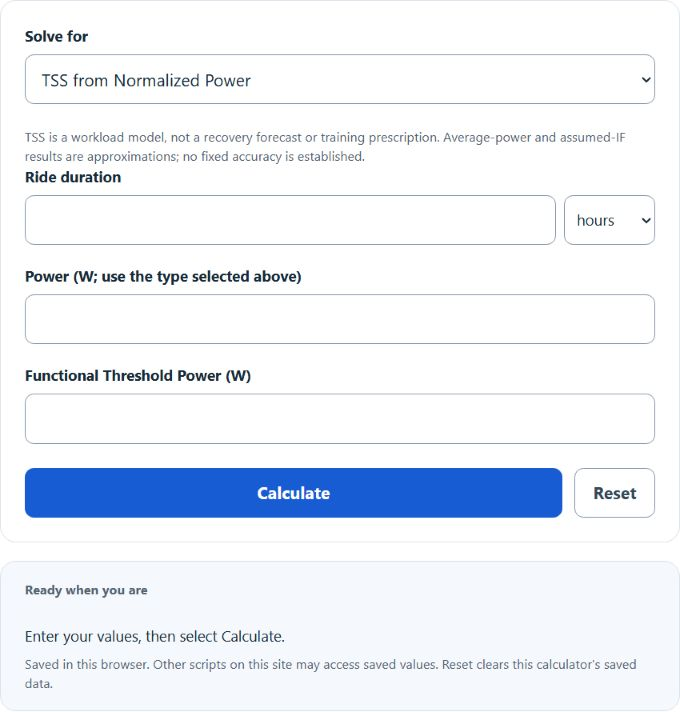
Calculate your cycling Training Stress Score (TSS) from power, FTP, and ride time, or find the ride time and power you need to hit a target TSS.
Cycling Training Stress Score (TSS) Formula
TSS = (t * NP * IF) / (FTP * 3600) * 100
IF = NP / FTP
- TSS is the Training Stress Score for the ride (unitless)
- t is the ride duration in seconds
- NP is the Normalized Power for the ride in watts
- IF is the Intensity Factor, your Normalized Power divided by your FTP
- FTP is your Functional Threshold Power in watts, the highest power you can sustain for about an hour
Because IF equals NP divided by FTP, the formula simplifies to a version that is easier to work with when planning rides:
TSS = hours * IF^2 * 100
The calculator solves TSS, duration or required Normalized Power. TSS and duration accept measured Normalized Power, an explicitly labelled average-power approximation, or your entered IF assumption. Time = TSS / (100 × IF²); required NP = FTP × sqrt(TSS / (100 × hours)). It does not infer IF from perceived effort or reconstruct NP from average power.
By definition, riding at exactly your FTP for one hour produces a TSS of 100. Scores are relative to the entered threshold. Equal scores do not guarantee equal physiological response or recovery.
TSS Earned Per Hour at Different Intensities
Because TSS scales with the square of the Intensity Factor, small changes in intensity have a large effect on how quickly training stress accumulates. This table shows the TSS you earn per hour at common intensities and how long you would need to ride to accumulate 100 TSS at each one.
| Intensity Factor (IF) | Typical effort | TSS per hour | Time to earn 100 TSS |
|---|---|---|---|
| 0.55 | Recovery spin | 30 | 3 h 18 min |
| 0.65 | Easy endurance | 42 | 2 h 22 min |
| 0.75 | Tempo | 56 | 1 h 47 min |
| 0.85 | Sweet spot | 72 | 1 h 23 min |
| 0.95 | Threshold intervals | 90 | 1 h 6 min |
| 1.00 | FTP effort | 100 | 1 h 0 min |
| 1.05 | Short race or hard intervals | 110 | 54 min |
The historical score categories below are rough descriptive bands, not individual recovery predictions. Duration, intensity pattern, sleep, health and training history matter.
| Single ride TSS | Training load | Expected recovery |
|---|---|---|
| Under 150 | Low | Not individually predicted |
| 150 to 300 | Medium | Not individually predicted |
| 300 to 450 | High | Not individually predicted |
| Over 450 | Very high | Not individually predicted |
Example Problems
Example 1: TSS for a completed ride. You rode for 1 hour 30 minutes with a Normalized Power of 210 W, and your FTP is 250 W. First find the Intensity Factor: IF = 210 / 250 = 0.84. Then apply the simplified formula: TSS = 1.5 * 0.84^2 * 100 = 1.5 * 0.7056 * 100 = 105.8. The ride scores about 105.8 TSS, a workload estimate that does not establish next-day recovery.
Example 2: Ride time for a target TSS. You want a 200 TSS endurance day at an easy pace of IF 0.65. Rearranging the formula: hours = 200 / (0.65^2 * 100) = 200 / 42.25 = 4.73 hours, or about 4 hours 44 minutes. To bank the same 200 TSS at tempo (IF 0.75), you would only need 200 / 56.25 = 3.56 hours, about 3 hours 33 minutes.
Frequently Asked Questions
Can you calculate TSS without a power meter? You can use an entered IF assumption for planning arithmetic. Perceived effort does not define a validated IF, and no fixed 10–15% accuracy is established. Heart-rate-based hrTSS is a separate method and is not implemented here.
How much TSS should you accumulate per week? This calculator does not prescribe a weekly score, progression percentage or recovery schedule. Use your own history and appropriate coaching; a numerical target alone does not establish a safe workload. See TrainingPeaks TSS estimation and its IF definition.
Why does this TSS differ slightly from TrainingPeaks or my head unit? Training platforms compute Normalized Power from your second-by-second power file using a 30-second rolling average raised to the fourth power, then averaged. When you type in a single NP value here, rounding, threshold settings and processing differences can affect the score. Average power is not Normalized Power, and differences can be substantial on variable rides. For steady indoor trainer sessions the two are nearly identical.