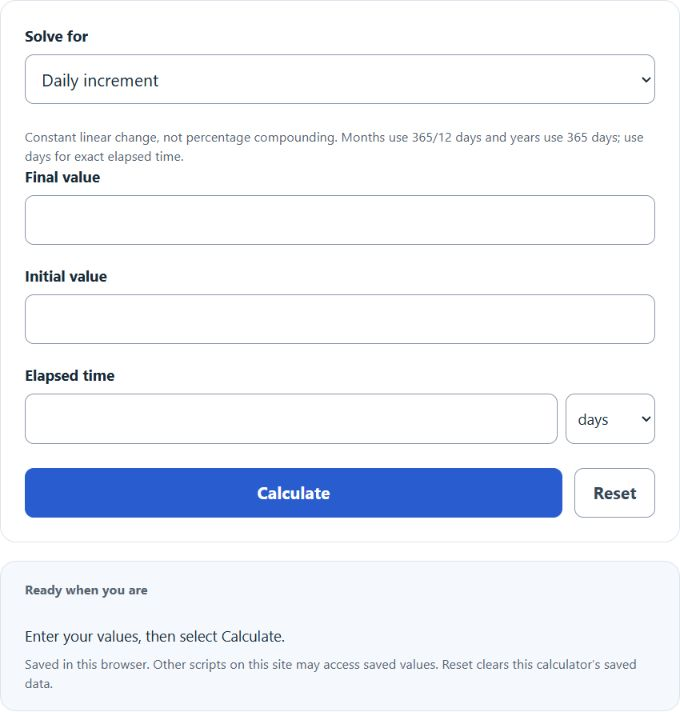
Choose daily increment, final value, initial value or elapsed time and enter the displayed inputs. The model uses constant linear change, with days, weeks, estimated months or estimated years.
Related Calculators
- Annual Change Calculator
- Increase Ratio Calculator
- Log Growth Rate Calculator
- Percentage Calculator
- All Math and Numbers Calculators
Daily Increment Formula
The daily increment is the amount added or subtracted each day to move from an initial value to a final value over a set number of days.
- DI = daily increment
- FV = final value
- IV = initial value
- D = number of days
The calculator can also rearrange the same relationship to solve for the missing value:
Choose the value to solve for and enter the three displayed inputs. The calculator uses the matching rearranged formula. If you enter weeks, months, or years for the time period, the value is converted to days before the daily increment is calculated.
Time Unit Conversions Used
The number of days field supports several time units. These are the conversion factors used before the calculation is made.
| Selected Unit | Conversion to Days | Example |
|---|---|---|
| Days | 1 day | 10 days = 10 days |
| Weeks | 7 days | 2 weeks = 14 days |
| Months | 365/12 days (approximately 30.416667) | 3 months = 91.25 days |
| Years | 365 days | 1 year = 365 days |
Daily Increment Result Meaning
| Result | Meaning |
|---|---|
| Positive daily increment | The value increases by that amount each day. |
| Negative daily increment | The value decreases by that amount each day. |
| Zero daily increment | The initial and final values are the same. |
Example
Example 1: Find the daily increment
You start at 100 and want to reach 160 after 30 days.
The daily increment is 2 per day.
Example 2: Find the final value
Your initial value is 50, the daily increment is 1.5, and the time period is 4 weeks. First convert weeks to days.
The final value is 92.
FAQ
Can the daily increment be negative?
Yes. A negative daily increment means the value is going down each day. For example, if the initial value is 100, the final value is 70, and the time period is 10 days, the daily increment is -3 per day.
Why do I need to select the value to solve for?
The formula needs three known values to solve for the fourth. Selecting the result displays its required inputs. A zero daily increment cannot determine a unique time for unchanged values or reach a different final value; elapsed time cannot be negative.
How are months handled?
Months use exactly 365/12 days in this model (approximately 30.416667), and years use 365 days. Calendar months vary and leap years have 366 days. This is useful for estimates, but if you need an exact calendar-based result, use the exact number of days instead.