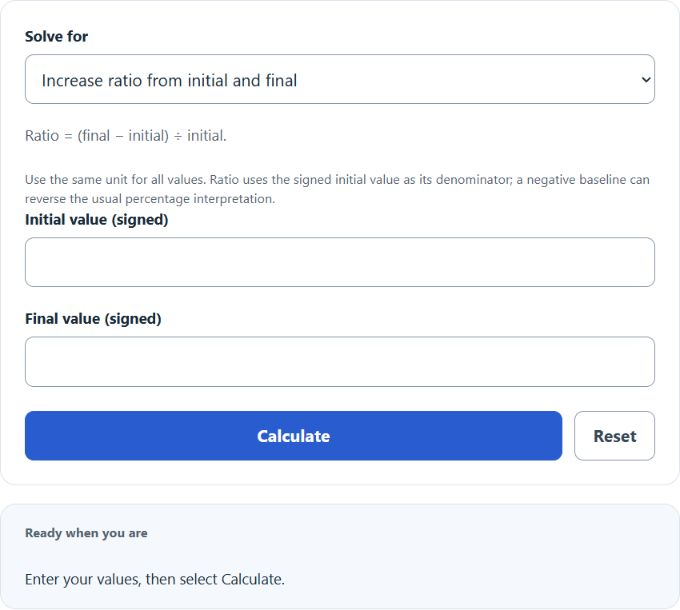
Choose increase ratio, total change, initial value or final value. Enter the two quantities required by that task; ratio inputs accept decimal or percentage units.
- All Math and Numbers Calculators
- All Ratio Calculators
- Improvement Percentage Calculator
- Percent To Ratio Calculator
- Ratio to Percent Calculator
Increase Ratio Formula
The following formula is used to calculate the Increase Ratio.
IR = TI / IV
- Where IR is the Increase Ratio
- IV is the initial value
- TI is the total increase (final value − initial value)
Divide total change by the nonzero initial value. Percent change equals the decimal ratio ×100. The final/initial multiplier equals1 + ratio. Negative initial values retain their signed denominator and need care in interpretation. To reverse the model, choose Initial value (change ÷ ratio), Total change (initial × ratio), or Final value (initial × (1 + ratio)). Zero ratio and zero change have no unique initial value.
How to Calculate Increase Ratio?
The following example problems outline how to calculate the Increase Ratio.
Example Problem #1:
- First, determine the initial value.
- The initial value is given as 5.
- Next, determine the final value.
- The final value is provided as 15.
- Finally, calculate the total increase (TI = final − initial), then compute the Increase Ratio: IR = TI / IV (multiply by 100 to express it as a percent).
IR = (FV − IV) / IV
The values given above are inserted into the equation below and the solution is calculated:
TI = 15 − 5 = 10; IR = 10 / 5 = 2.0000 (decimal) = 200.00%
Example Problem #2:
For this problem, the variables required are provided below:
initial value = 6
final value = 8
Test your knowledge using the equation and check your answer with the calculator above.
IR = (FV − IV) / IV = (8 − 6) / 6 = ?