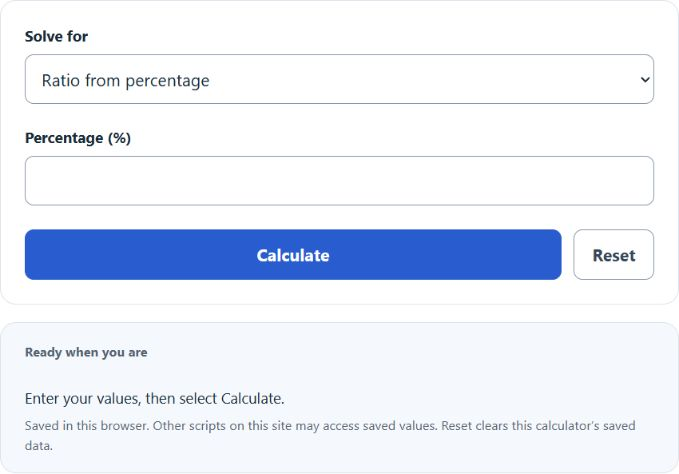
Select the conversion, enter a percentage or an A:B ratio, then select Calculate. Results include normalized X:1 form and a reduced ratio for decimal percentage inputs.
Percent to Ratio Formula
A percent is always a value out of 100. To convert a percentage into a ratio, first write it as a comparison against 100, then simplify if needed. This calculator also shows the result in X:1 form, which is useful when comparing a value directly to one unit of the base amount.
Where P is the percentage and R is the ratio written as X:1. For example, a value of 150% means the first quantity is 1.5 times the base quantity, so the normalized ratio is 1.5:1.
Reverse Formula
If you already know the ratio in X:1 form and want the equivalent percentage, multiply the first term by 100.
This is why a ratio of 0.75:1 corresponds to 75%, and a ratio of 2:1 corresponds to 200%.
How to Convert Percent to Ratio
- Write the percent as a ratio over 100.
- Simplify both parts if you want the ratio in smallest whole-number form.
- Divide the percentage by 100 if you want the calculator’s normalized X:1 output.
In practice, the same percentage can often be shown in two equivalent ways: as a simplified whole-number ratio and as an X:1 ratio.
Example Conversions
Twenty-five percent
Fifty percent
One hundred percent
One hundred fifty percent
Twelve and a half percent
How to Interpret the Result
- Less than 100% gives a ratio smaller than 1:1, meaning the first quantity is smaller than the base quantity.
- Exactly 100% gives 1:1, meaning the two quantities are equal.
- More than 100% gives a ratio greater than 1:1, meaning the first quantity is larger than the base quantity.
- Zero percent means the first quantity is zero relative to a nonzero base.
When the result is displayed as X:1, you can read it like a multiplier. A ratio of 0.5:1 means “half as much as the base,” while 2.25:1 means “2.25 times the base.”
Why the Ratio May Look Different Than Expected
Some users expect 50% to be written only as 1:2. That is correct in standard simplified ratio form. The calculator’s 0.5:1 result is also correct because it normalizes the comparison to one unit on the right side. Both forms describe the same relationship.
Helpful Conversion Tips
- If the percentage includes decimals, keep enough precision before simplifying.
- If you want a whole-number ratio, clear any decimals first and then reduce the ratio.
- Use X:1 form when thinking in terms of scale factor, growth factor, markup, or multiplier.
- Use simplified whole-number form when comparing two countable quantities directly.
Where Percent-to-Ratio Conversion Is Useful
Percent-to-ratio conversion is common in finance, classroom grading, recipe scaling, engineering tolerances, concentration calculations, discounts, performance comparisons, and any situation where a percent must be restated as a direct relationship between two quantities. The calculator above makes that conversion immediate whether you need a normalized ratio or a simplified ratio form.