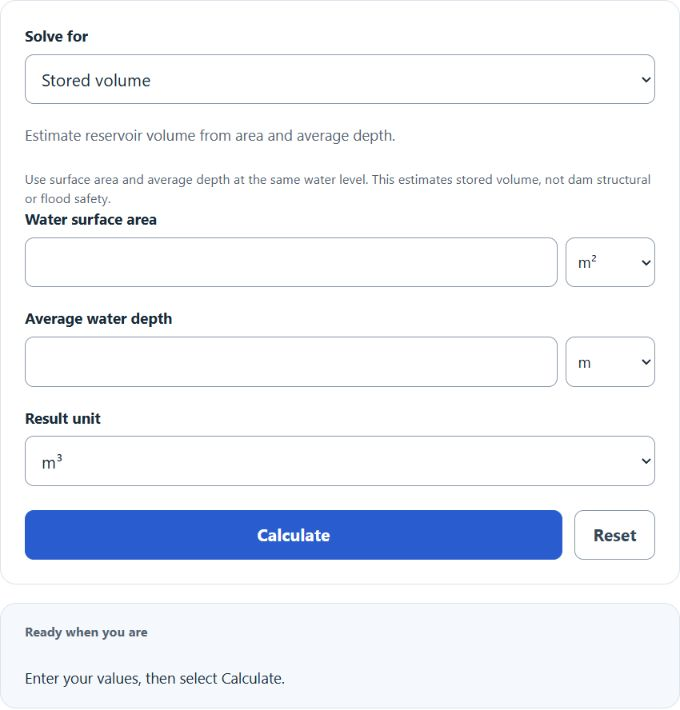
Choose stored volume, surface area, or average depth and enter the other two quantities at the same water level. Results support m³, ft³, acre-feet, m², ft², acres, m, ft, or in.
Related Calculators
- Inlet Capacity Calculator
- Dip Volume Calculator
- Lag Time Calculator
- Ground Pressure Calculator
- All Construction Calculators
Dam Capacity Formula
The basic dam capacity formula estimates stored water volume from the reservoir surface area and average depth:
- DC = dam capacity or reservoir volume
- SA = surface area of the stored water
- AD = average depth of the stored water
If you know dam capacity and average depth, the calculator rearranges the formula to find surface area:
If you know dam capacity and surface area, the calculator rearranges the formula to find average depth:
Using the international foot (0.3048 m exactly), the calculation is performed in metric base units first: cubic meters for capacity, square meters for surface area, and meters for depth. The result is then converted back to the unit you selected, such as cubic feet, acre-feet, acres, feet, or inches.
- Calculate dam capacity: enter surface area and average depth.
- Calculate surface area: enter dam capacity and average depth.
- Calculate average depth: enter dam capacity and surface area.
Common Dam Capacity Unit Conversions
| Measurement | Conversion | Used for |
|---|---|---|
| 1 cubic foot | 0.028316846592 cubic meters | Small volume calculations |
| 1 acre-foot | 1,233.48183754752 cubic meters | Reservoir and irrigation storage |
| 1 acre | 4,046.8564224 square meters | Reservoir surface area |
| 1 foot | 0.3048 meters | Water depth |
Approximate Capacity by Surface Area and Depth
| Surface Area | Average Depth | Approximate Capacity |
|---|---|---|
| 1 acre | 1 ft | 1 acre-foot |
| 1 acre | 10 ft | 10 acre-feet |
| 5 acres | 8 ft | 40 acre-feet |
| 10,000 m² | 3 m | 30,000 m³ |
Example Dam Capacity Calculations
Example 1: Calculate dam capacity
You have a reservoir surface area of 10,000 m² and an average depth of 4 m.
The dam capacity is 40,000 m³.
Example 2: Calculate average depth
You have a dam capacity of 60 acre-feet and a surface area of 12 acres.
The average depth is 5 ft. This acre-foot shortcut works because 1 acre-foot equals 1 acre covered by 1 foot of water.
FAQ
What does dam capacity mean?
Dam capacity is the volume of water stored behind a dam or in a reservoir. It is commonly measured in cubic meters, cubic feet, or acre-feet. This calculator estimates capacity using surface area and average depth, so the result is an approximate storage volume.
Why does the calculator use average depth instead of maximum depth?
Maximum depth is only the deepest point. Reservoir bottoms are uneven, so using maximum depth for the whole area would usually overstate capacity. Average depth gives a better estimate because it represents the overall depth across the reservoir surface.
Is this formula accurate for an irregular reservoir?
It is an estimate. The formula assumes that capacity can be approximated as surface area multiplied by average depth. For irregular basins, changing water levels, sloped sides, sediment buildup, or detailed engineering work, capacity is usually measured with survey data or a stage-storage curve.