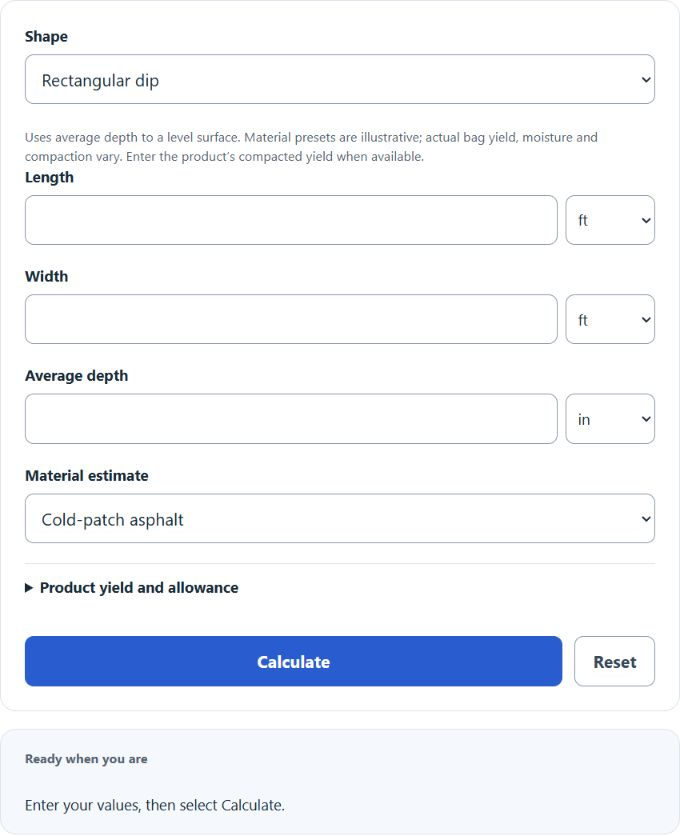
Calculate how many bags of asphalt, gravel, sand, or fill dirt you need to fill a dip or pothole from its dimensions or area and depth.
Related Calculators
- Driveway Slope Calculator
- Playground Mulch Calculator
- Exterior Square Footage Calculator
- Excavator Cycle Time Calculator
- All Construction Calculators
Dip Volume Formula
The following formula is used to calculate the dip volume for a given surface area and depth.
Variables:
- V is the dip volume
- A is the surface area of the dip
- D is the average depth of the dip
For a level fill surface, multiply plan area by average depth using consistent units. Rectangular and round modes approximate a prism and cylinder. Material densities and package weights are illustrative estimates; use the selected product’s compacted volume yield for a product-specific bag count.
What is a Dip Volume?
Dip volume refers to the total volume of a depression or hollow in a surface, typically measured in cubic units. This can be useful in various fields such as geology, construction, and manufacturing, where understanding the volume of a dip can help in planning and analysis. For a level fill surface, estimate the dip volume by multiplying plan area by its average depth. Using the maximum depth for an irregular dip can overestimate the required fill.
How to Calculate Dip Volume?
The following steps outline how to calculate the Dip Volume.
- First, determine the surface area of the dip (A).
- Next, determine the average depth of the dip (D).
- Finally, calculate the dip volume using the formula V = A * D.
- After inserting the values and calculating the result, check your answer with the calculator above.
Example Problem :
Use the following variables as an example problem to test your knowledge.
Surface area of the dip (A) = 50 square units
Depth of the dip (D) = 2 units