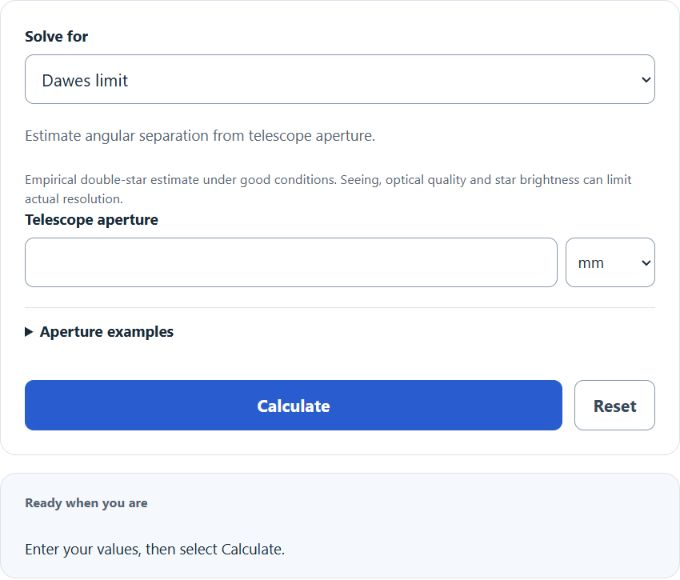
Calculate the Dawes limit from telescope aperture or find the aperture needed for a target resolution in arcseconds using the 116 ÷ aperture formula.
Related Calculators
- IFOV Calculator
- Aphelion Distance Calculator
- Polarization Calculator
- Frequency To Energy Calculator
- All Physics Calculators
Dawes Limit Formula
The Dawes limit is an empirical estimate of angular separation for close double stars, classically of similar brightness, under good observing conditions. The conventional formula below uses the rounded coefficient 116 with aperture in millimeters; it is not a guaranteed resolution or the Rayleigh criterion.
- θ = Dawes limit in arcseconds
- Dmm = telescope aperture in millimeters
- 116 = Dawes constant when aperture is measured in millimeters
To find the aperture needed for a target Dawes limit, the formula is rearranged:
- Dmm = required aperture in millimeters
- θ = desired Dawes limit in arcseconds
The calculator uses these formulas in two ways:
- Find Dawes limit: you enter the telescope aperture, and the calculator converts it to millimeters if needed, then calculates the Dawes limit in arcseconds.
- Find needed aperture: you enter a target Dawes limit, and the calculator calculates the aperture required to reach that theoretical resolution.
Typical Dawes Limits by Telescope Aperture
Lower Dawes limit values mean finer theoretical resolution. Actual observing conditions can prevent a telescope from reaching these values.
| Aperture | Aperture in mm | Approx. Dawes Limit |
|---|---|---|
| 60 mm | 60 mm | 1.93 arcsec |
| 80 mm | 80 mm | 1.45 arcsec |
| 114 mm | 114 mm | 1.02 arcsec |
| 6 in | 152.4 mm | 0.76 arcsec |
| 8 in | 203.2 mm | 0.57 arcsec |
Aperture Needed for Common Resolution Targets
| Target Dawes Limit | Required Aperture | Approx. Inches |
|---|---|---|
| 2.0 arcsec | 58 mm | 2.28 in |
| 1.5 arcsec | 77.33 mm | 3.04 in |
| 1.0 arcsec | 116 mm | 4.57 in |
| 0.5 arcsec | 232 mm | 9.13 in |
Example Problems
Example 1: Find the Dawes limit of an 80 mm telescope
Use the formula:
The result is:
θ = 1.45 arcseconds
Example 2: Find the aperture needed for a 1 arcsecond Dawes limit
Use the rearranged formula:
The result is:
D = 116 mm, which is about 4.57 inches.
FAQ
What does the Dawes limit mean?
The Dawes limit estimates how close two similar-brightness stars can appear and still be distinguished under good conditions. A smaller value indicates finer estimated angular resolution. It is not a universal criterion for every object or an assurance of actual observing performance.
Does a lower Dawes limit always mean a better view?
Not always. A lower Dawes limit means better theoretical resolution, but real viewing depends on atmospheric seeing, telescope collimation, optical quality, focus, thermal stability, and observer experience. In poor seeing, a larger telescope may not reach its theoretical Dawes limit.
Is Dawes limit the same as magnification?
No. Dawes limit is based on aperture, not magnification. Magnification makes the image appear larger, but it does not create more resolving power beyond what the aperture and conditions allow.