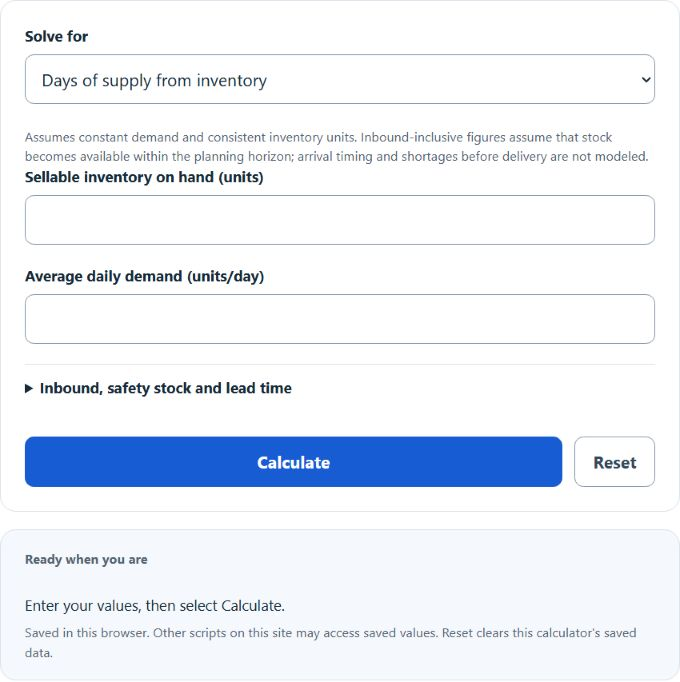
Calculate days of supply, target inventory and order quantity, or supported demand with separate on-hand, inbound, safety stock, and lead-time planning.
Related Calculators
- Lead Time Calculator
- Average Daily Sales Calculator
- Perpetual Inventory Calculator
- Batch Size Calculator
- All Business Calculators
Days Of Supply Formula
The basic days of supply calculation estimates how long your current inventory will last at a constant daily usage rate.
- DOS = days of supply
- IOH = inventory on hand
- DUR = daily usage rate
In Order needed for target coverage mode, target stock before subtracting current and inbound supply is daily demand × target days + safety stock. With no safety stock, the basic relationship is:
In Supported daily demand mode, the calculator divides supply above protected safety stock by target days. With no inbound or safety stock, the basic relationship is:
For the Days in Inventory mode, the calculator uses average inventory at cost, cost of goods sold, and the period length.
- DII = days in inventory
- AI = average inventory at cost
- COGS = cost of goods sold for the period
- PD = period length in days
Choose an explicit solve mode for coverage, the additional inventory needed, or supported daily demand. Optional inbound and safety stock are included as labeled; blank values mean zero. The financial mode calculates average days in inventory from compatible cost figures and a period length. Inbound timing and changing demand require separate planning.
Common Days of Supply Interpretations
| Days of supply result | What it usually means | Possible action |
|---|---|---|
| Very low | Inventory may run out soon if demand continues. | Review reorder timing, supplier lead time, or usage assumptions. |
| Near target | Inventory is close to the planned coverage level. | Continue monitoring demand and replenishment timing. |
| Very high | Inventory may be moving slowly or overstocked. | Check demand forecasts, holding costs, and slow-moving items. |
Period Lengths Used in the Calculator
| Selected period unit | Days used |
|---|---|
| 1 day | 1 day |
| 1 week | 7 days |
| 1 month | 30 days |
| 1 year | 365 days |
Days Of Supply Example
Example 1: Calculate days of supply.
You have 1,200 units on hand and use 80 units per day.
The days of supply is 15 days.
Example 2: Calculate days in inventory.
Your average inventory at cost is $50,000, your COGS is $300,000, and the period is 365 days.
The days in inventory is 60.83 days.
Days Of Supply Calculator FAQ
How many days of supply is a good target?
A good days-of-supply target depends on your product, lead time, demand variability, and storage cost. A fast-moving item with reliable suppliers may need fewer days of supply. A critical item with long lead times may need more. Compare the result to your reorder policy, safety stock target, and expected demand rather than using one fixed number for every item.
What is the difference between days of supply and days in inventory?
Days of supply usually uses physical units: inventory on hand divided by daily usage. Days in inventory usually uses financial values: average inventory divided by COGS, multiplied by the period length. Both measure inventory coverage, but they are used in different contexts. Use days of supply for operational stock planning and days in inventory for financial or accounting analysis.
Why does the calculator require daily usage to be greater than zero?
Daily usage must be greater than zero because days of supply divides inventory by usage. If usage is zero, inventory is not being consumed, so the formula cannot produce a meaningful finite number of days. If demand is temporarily zero, use an expected average daily usage rate instead.