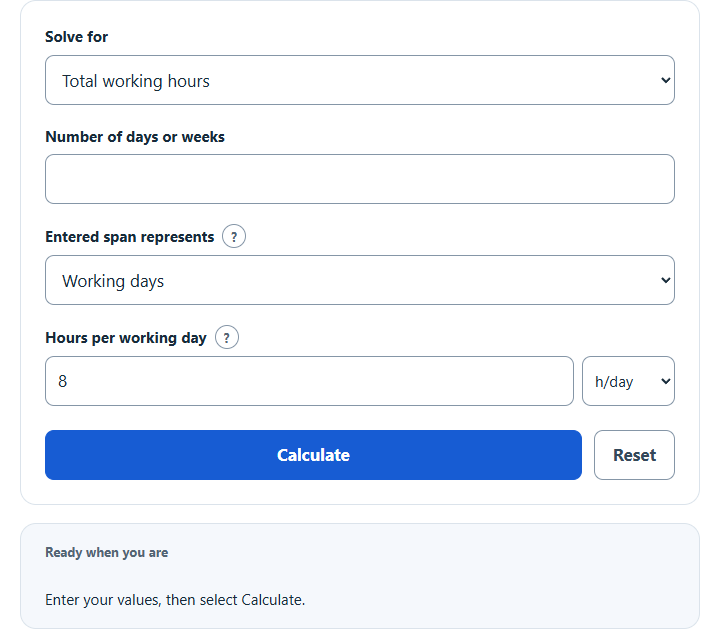
Convert working days to hours at 8 hours a day or your own schedule, turn hours back into working days, and see the 24-hour clock-hour equivalent.
- All Unit Converters
- Weeks To Working Days Calculator
- Man Hours To Man Days Calculator
- Hours Of Experience Calculator
- Hours Of Service Calculator
Calculator Functions
| Function | What it does | What it requires |
|---|---|---|
| Total working hours | Converts a number of days or weeks to the working hours they contain | Requires the number of days or weeks, what that span represents and the hours per working day |
| Working days from total hours | Converts a total of working hours to working days | Requires the total working time and the hours per working day |
| Hours per working day | Finds the daily hours needed to fit a total of working time into a number of days | Requires the number of days or weeks, what that span represents and the total working time |
The span can be working days, working weeks, calendar days or calendar weeks. Any choice other than working days also asks for the working days per week, which starts at 5. Hours per working day starts at 8, can be entered in hours, minutes or seconds and cannot exceed 24. Every result also gives the total in minutes and seconds, and the clock hours in the same span at 24 hours per day.
Days to Working Hours Formulas
| WH | Total working hours |
| D | Number of working days |
| H | Hours per working day, 8 unless changed |
Total working hours
Working days go straight into the formula: 20 working days at 8 hours are 160 working hours. Other spans are turned into working days first, where d is the working days per week:
D = calendar days × d ÷ 7
Two working weeks of 5 days at 7.5 hours are 10 × 7.5 = 75 hours. Thirty calendar days on a 5 day week average 30 × 5 ÷ 7 = 21.43 working days, or 171.43 hours at 8 hours per day. The table gives working hours for common day counts, next to the clock hours in the same number of full days.
| Working days | Hours at 8 h/day | Hours at 7.5 h/day | Clock hours (24 h/day) |
|---|---|---|---|
| 0.25 | 2 | 1.88 | 6 |
| 0.5 | 4 | 3.75 | 12 |
| 0.75 | 6 | 5.63 | 18 |
| 1 | 8 | 7.5 | 24 |
| 1.5 | 12 | 11.25 | 36 |
| 2 | 16 | 15 | 48 |
| 2.5 | 20 | 18.75 | 60 |
| 3 | 24 | 22.5 | 72 |
| 4 | 32 | 30 | 96 |
| 5 | 40 | 37.5 | 120 |
| 7 | 56 | 52.5 | 168 |
| 8 | 64 | 60 | 192 |
| 10 | 80 | 75 | 240 |
| 14 | 112 | 105 | 336 |
| 15 | 120 | 112.5 | 360 |
| 16 | 128 | 120 | 384 |
| 19 | 152 | 142.5 | 456 |
| 20 | 160 | 150 | 480 |
| 25 | 200 | 187.5 | 600 |
| 30 | 240 | 225 | 720 |
| 40 | 320 | 300 | 960 |
| 90 | 720 | 675 | 2,160 |
Working days from total hours
480 hours at 8 hours per day are 60 working days, and 200 hours at 7.5 hours per day are 26.67. The result also shows the same hours as calendar days of 24 hours, which for 480 hours is 20.
| Total hours | Working days at 8 h/day | Working days at 7.5 h/day |
|---|---|---|
| 40 | 5 | 5.33 |
| 48 | 6 | 6.4 |
| 72 | 9 | 9.6 |
| 80 | 10 | 10.67 |
| 100 | 12.5 | 13.33 |
| 120 | 15 | 16 |
| 150 | 18.75 | 20 |
| 160 | 20 | 21.33 |
| 200 | 25 | 26.67 |
| 240 | 30 | 32 |
| 320 | 40 | 42.67 |
| 400 | 50 | 53.33 |
| 480 | 60 | 64 |
| 600 | 75 | 80 |
| 1,000 | 125 | 133.33 |
| 1,040 | 130 | 138.67 |
| 1,200 | 150 | 160 |
| 2,080 | 260 | 277.33 |
| 3,840 | 480 | 512 |
Hours per working day
Twenty hours spread over 3 working days come to 6.67 hours per day, and 42 hours over 5 days come to 8.4. An answer above 24 hours per day is rejected, as is a span of zero days.
Limits of This Estimate
- Calendar days and calendar weeks are averaged over the working days per week. Actual weekends, public holidays and leave are not counted, so a short span that starts or ends mid-week can differ by a day or two.
- Every working day is given the same number of hours. Schedules with short days, unpaid breaks or overtime need the real daily figures added up.
- This is a time conversion. It is not a payroll, overtime or legal working-hours calculation.