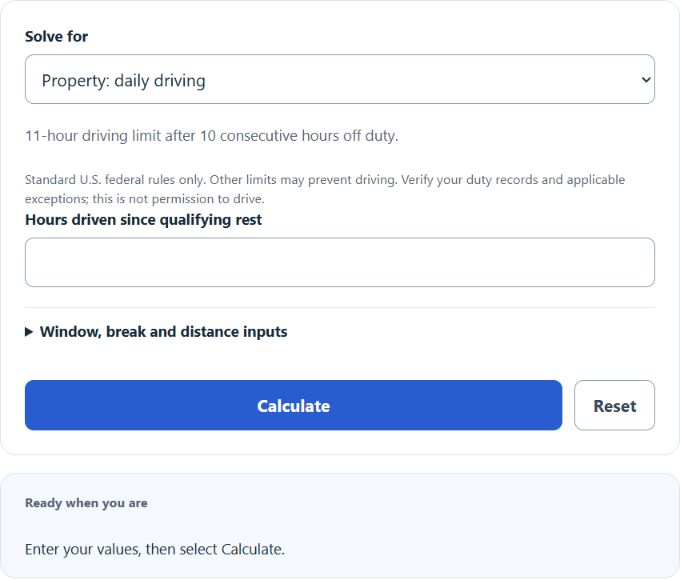
Estimate standard federal daily-driving and 7/8-day cycle balances for property or passenger drivers. Optional inputs check window and property-driver break components. These arithmetic balances do not determine permission to drive.
Related Calculators
- Break Time Calculator
- Subtract Time Calculator
- Billable Hours Calculator
- Hours to Decimal Calculator
- Tenth of an Hour Calculator
- Man Hours to Man Days Calculator
- All Automotive Calculators
Hours of Service Formula
Each remaining component is calculated as its standard limit minus the recorded hours used, with negative balances shown as zero. See the FMCSA HOS summary.
Variables:
- Hr is the remaining balance for the selected limit
- L is the applicable driving or rolling-cycle limit
- U is the driving or on-duty hours used for that component
Property drivers generally have an 11-hour driving limit after 10 consecutive hours off duty and a 14-hour elapsed window. Passenger drivers generally have a 10-hour driving limit after 8 consecutive hours off duty and a 15-hour on-duty limit that excludes off-duty time. A property driver needs 30 consecutive non-driving minutes after 8 cumulative driving hours. The rolling cycle is 60 on-duty hours in 7 days or 70 in 8 days, based on the carrier schedule. The 34-hour cycle restart applies to property drivers. Qualifying rest, exemptions, sleeper splits, adverse conditions and state rules are not evaluated.
What is Hours of Service?
Hours of Service (HOS) regulations are designed to prevent accidents caused by driver fatigue. These regulations specify the maximum number of hours a driver can work and drive, as well as the minimum amount of rest they must take. The goal is to ensure that drivers are well-rested and alert, thereby improving road safety. HOS regulations are particularly important in industries such as trucking and transportation, where long hours on the road are common.
How to Calculate Hours of Service?
The following steps outline how to calculate the Hours of Service.
- First, select the property or passenger rule and the daily or cycle component.
- Next, enter driving hours since qualifying rest or on-duty hours in the applicable rolling cycle. Midnight alone does not reset a shift.
- Finally, calculate the component balance. Check your other clocks, duty record and applicable rules before driving.
- After inserting the values and calculating the result, check your answer with the calculator above.
Example Problem :
Use the following variables as an example problem to test your knowledge.
Property-driver driving limit = 11 hours; driving since qualifying rest = 10 hours.
Daily driving-limit balance = 11 − 10 = 1 hour. Other limits may prevent further driving.