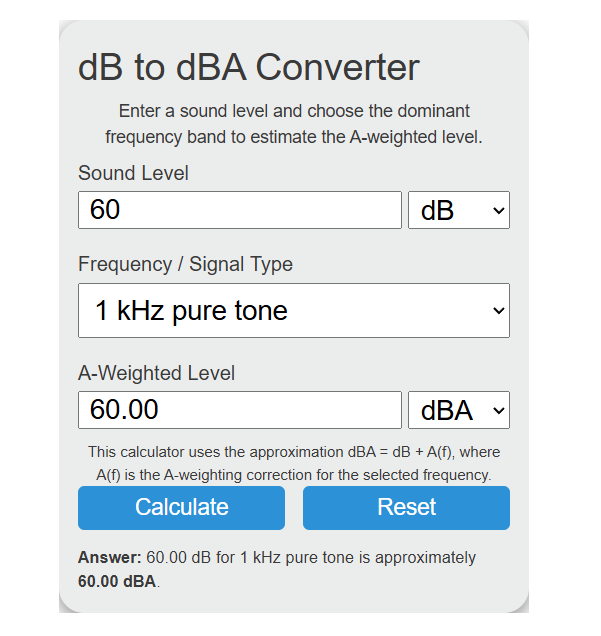
Enter the sound level in decibels and select the frequency or signal type to determine the approximate A-weighted sound level in dBA.

dB to dBA Converter

Enter a sound level and choose the dominant frequency band to estimate the A-weighted level.

This calculator uses the approximation dBA = dB + A(f), where A(f) is the A-weighting correction for the selected frequency.

dB to dBA Formula

The following formula is used to calculate an approximate A-weighted sound level for a narrow-band or single-frequency signal.

dBA = dB + A(f)

Variables:

  • dBA is the A-weighted sound level
  • dB is the unweighted sound level
  • A(f) is the A-weighting correction at frequency f

To calculate dBA, take the original sound level in dB and add the A-weighting correction for the selected frequency. At 1 kHz the correction is about 0 dB, while at lower frequencies the correction is negative, which lowers the dBA value.

What is dB to dBA Conversion?

dB to dBA conversion is the process of adjusting a sound level measurement so it better reflects how the human ear perceives loudness. A plain dB reading is unweighted, meaning it does not account for the ear being less sensitive to very low and very high frequencies. A dBA reading applies the standard A-weighting curve, which reduces the contribution of frequencies the ear hears less strongly.

This means there is no single fixed multiplier between dB and dBA. The correct conversion depends on the frequency content of the sound. For simple pure tones or narrow-band signals, the approximation dBA = dB + A(f) is often used for quick estimates.

Common A-Weighting Corrections

The following A-weighting corrections are commonly used for quick dB to dBA estimates:

  • 1 kHz: A(f) ≈ 0 dB
  • 500 Hz: A(f) ≈ -3.2 dB
  • 250 Hz: A(f) ≈ -8.6 dB
  • 125 Hz: A(f) ≈ -16.1 dB
  • 100 Hz: A(f) ≈ -19.1 dB
  • 63 Hz: A(f) ≈ -26.2 dB
  • 50 Hz: A(f) ≈ -30.2 dB

How to Convert dB to dBA?

The following steps outline how to convert dB to dBA.


  1. First, determine the unweighted sound level in dB.
  2. Next, identify the dominant frequency or narrow-band signal type.
  3. Then, find the A-weighting correction A(f) for that frequency.
  4. Finally, calculate the approximate A-weighted level using dBA = dB + A(f).
  5. After calculating the result, check your answer with the calculator above.

dB to dBA Conversion Table

The table below shows example conversions for a 60 dB unweighted sound level at several common frequencies.

Signal Type A(f) (dB) 60 dB in dBA
1 kHz pure tone 0.0 60.0 dBA
500 Hz pure tone -3.2 56.8 dBA
250 Hz pure tone -8.6 51.4 dBA
125 Hz pure tone -16.1 43.9 dBA
100 Hz pure tone -19.1 40.9 dBA
63 Hz pure tone -26.2 33.8 dBA
50 Hz pure tone -30.2 29.8 dBA

For real-world broadband sounds, dBA is found by applying the A-weighting curve across the full spectrum before calculating the overall level. Because of that, the simple method above is most accurate for pure tones or narrow-band signals and is best used as an estimate for quick comparisons.

Example Problem:

Use the following values as an example problem to test your knowledge.

Sound Level (dB) = 60

Frequency = 100 Hz

A-weighting Correction = -19.1 dB

dBA = 60 + (-19.1) = 40.9 dBA