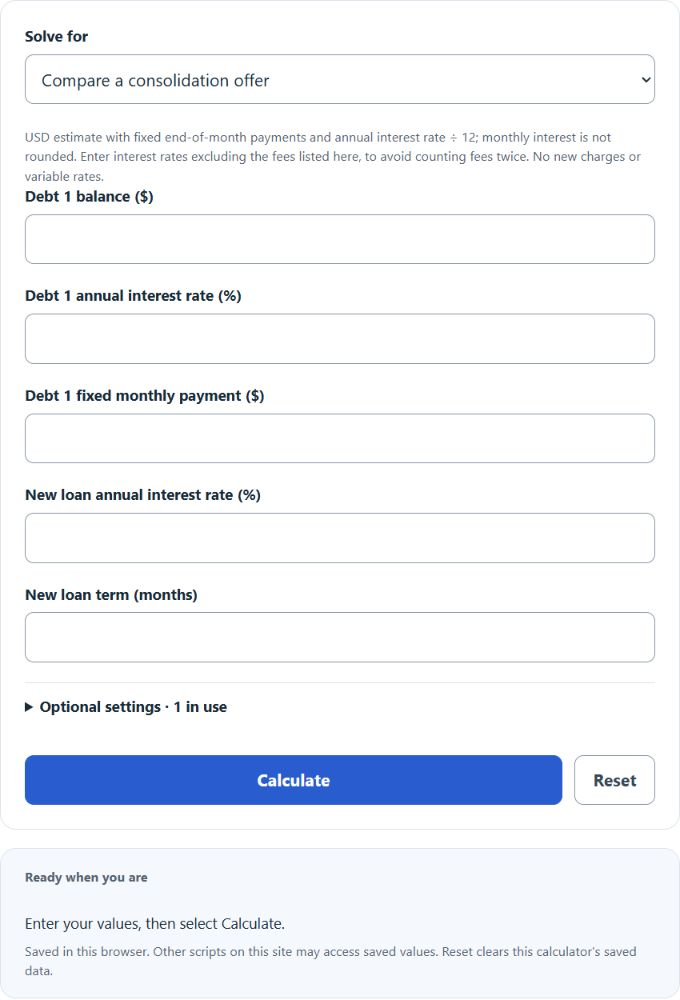
Use this debt consolidation calculator to compare payments, payoff time, fees, and interest, or find the maximum consolidation annual interest rate that breaks even.
Debt Consolidation Formula
A consolidation loan is modeled as a fixed-rate amortizing loan. Its monthly payment is shown below. Enter the loan interest rate excluding fees modeled separately; a lender-disclosed APR may already include fees.
M = P * [r(1 + r)^n] / [(1 + r)^n - 1]
The cost comparison is:
S = C_current - C_new
Variables:
- M is the new monthly payment
- P is the new principal, including financed fees when selected
- r is the monthly rate as a decimal: entered annual percentage rate / 1200
- n is the number of monthly payments
- S is estimated savings
- C_current and C_new are the remaining cash outlays under each option
The calculator simulates each current debt with its own balance, annual interest rate, and fixed payment, using end-of-month payments and unrounded monthly interest. It reduces the final payment and does not roll freed payments into other debts. It compares that remaining outlay with the proposed loan. Break-even mode estimates the highest annual interest rate that does not increase modeled outlay; this is not a fee-inclusive lender APR.
Debt Consolidation Cost Reference
A lower payment does not automatically mean a cheaper loan. Term length and fee treatment determine whether the consolidation actually reduces total cost.
| Change | Monthly payment | Total cost | What to watch |
|---|---|---|---|
| Lower annual interest rate, same term | Usually lower | Usually lower | Fees can offset part of the savings |
| Longer term | Usually lower | Can be higher | More months of interest |
| Fees financed | Slightly higher | Higher | Interest is charged on the fees |
| Fees paid upfront | Unchanged by fee | Higher by upfront amount | Requires cash at closing |
Example Problems
Example 1: Compare a consolidation offer.
You owe $7,000 at 21% with a $250 payment and $5,000 at 16% with a $180 payment. A lender offers a 48-month loan at 10% with a 3% origination fee. Enter both current debts and the new terms. The calculator compares the $430 current payment with the new payment and shows the difference in payoff time, interest, fees, and total remaining outlay.
Example 2: Find the maximum acceptable annual interest rate.
Keep the balances, current payments, new term, and fees the same, then choose the maximum-rate mode. The calculator searches for the new rate at which the consolidation’s total outlay is approximately equal to continuing the existing payments.
Frequently Asked Questions
Does debt consolidation reduce the amount I owe?
Not by itself. A consolidation loan usually replaces several balances with one new balance. Savings come from a lower rate, a shorter repayment path, lower fees, or a combination of those factors.
Should origination fees be included?
Yes. A fee paid upfront raises the immediate cost. A financed fee raises the principal and is also charged interest. Compare total outlay rather than the advertised rate alone.
Why is the current-debt result only an estimate?
Revolving accounts often use changing minimum-payment formulas and daily interest. The calculator holds each entered payment and annual interest rate constant to create a consistent comparison.