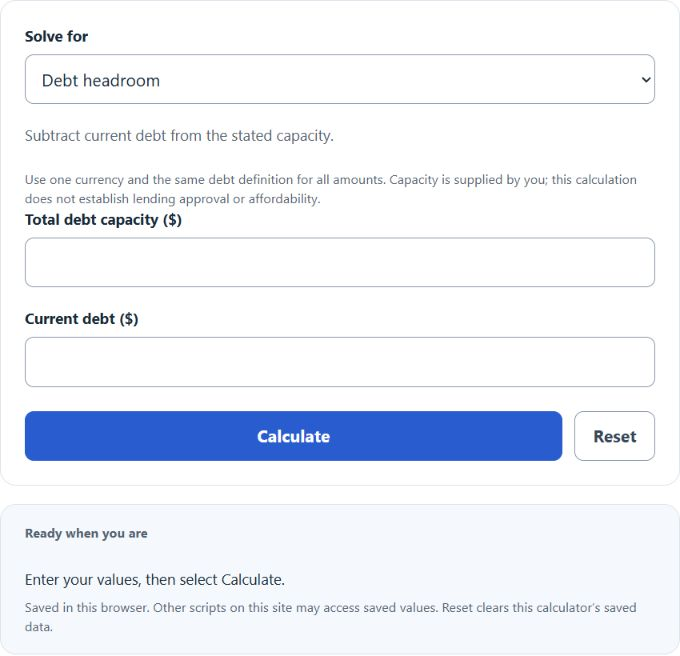
Choose debt headroom, total debt capacity, or current debt and enter the other two amounts. Use the same currency and debt definition.
Debt Headroom Formula
Debt headroom is the unused portion of your total debt capacity. The calculator can solve for debt headroom, total debt capacity, or current debt when you enter the other two values.
- DH = Debt headroom
- TDC = Total debt capacity
- CD = Current debt
If debt headroom is missing, the calculator subtracts current debt from total debt capacity.
If total debt capacity is missing, the calculator adds debt headroom and current debt.
If current debt is missing, the calculator subtracts debt headroom from total debt capacity.
Debt Headroom Result Guide
| Result | Meaning | Simple interpretation |
|---|---|---|
| Positive debt headroom | Current debt is below total debt capacity. | Debt is below the stated capacity; actual additional borrowing remains subject to applicable terms and approval. |
| Zero debt headroom | Current debt equals total debt capacity. | You are at the stated borrowing limit. |
| Negative debt headroom | Current debt is above total debt capacity. | Debt exceeds the stated capacity. |
Common Debt Capacity Inputs
| Input | What to include | Notes |
|---|---|---|
| Total debt capacity | The maximum debt amount allowed or supportable. | This may come from a lender limit, covenant limit, internal policy, or affordability estimate. |
| Current debt | Existing debt currently outstanding. | Use the same basis as total debt capacity, such as total principal balance or drawn debt. |
| Debt headroom | Unused borrowing capacity. | A higher number means more available room before reaching the capacity limit. |
Example
Example 1: Calculate debt headroom
You have a total debt capacity of $500,000 and current debt of $325,000.
The debt headroom is $175,000.
Example 2: Calculate total debt capacity
You have debt headroom of $80,000 and current debt of $220,000.
The total debt capacity is $300,000.
FAQ
What does debt headroom mean?
Debt headroom means the amount of additional debt that can be taken on before reaching a stated debt capacity. For example, if total debt capacity is $1,000,000 and current debt is $750,000, debt headroom is $250,000.
Can debt headroom be negative?
Yes. Negative debt headroom means current debt is greater than total debt capacity. For example, if total debt capacity is $400,000 and current debt is $450,000, debt headroom is -$50,000.
Should unused credit lines count as current debt?
Usually, only drawn or outstanding amounts are counted as current debt. However, the correct treatment depends on the purpose of the calculation. If a lender, covenant, or internal policy defines debt differently, use that definition for both current debt and total debt capacity.