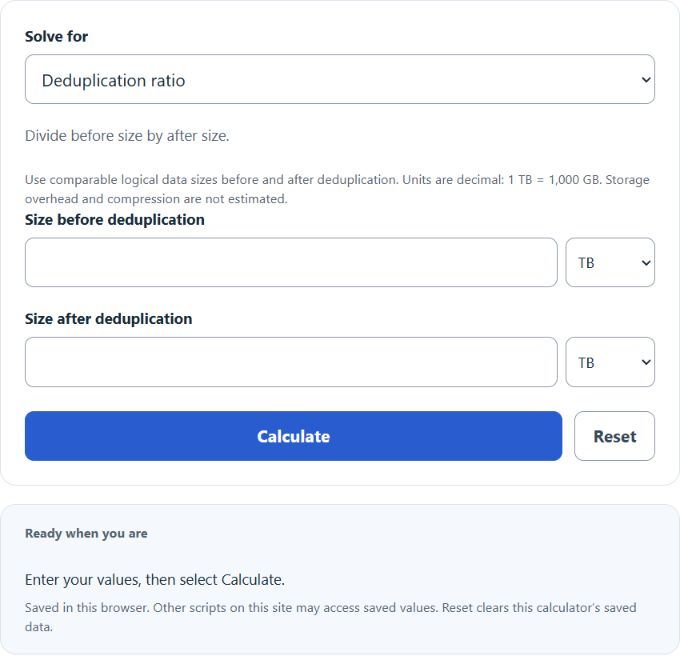
Calculate deduplication ratio, pre-dedup capacity, or post-dedup storage capacity by choosing a result and entering its two inputs in TB, GB, MB, or KB.
- All Miscellaneous Calculators
- All Ratio Calculators
- Throughput to IOPS Calculator
- Hit Ratio Calculator
- Bit Error Rate (BER) Calculator
Deduplication Ratio Formula
The deduplication ratio compares the amount of data before duplicate blocks or files are removed to the amount of data stored after deduplication.
To calculate the original capacity before deduplication:
To calculate the post-deduplication capacity:
- DR = deduplication ratio, unitless
- C_before = total capacity of backed-up data before removing duplicates
- C_after = capacity after removing duplicates
Choose the result to calculate, then enter its two inputs. If you enter the before and after capacities, it calculates the deduplication ratio. If you enter the ratio and one capacity value, it calculates the missing capacity value.
Capacity units can be entered as TB, GB, MB, or KB. The calculation converts capacity values to a common base unit first, then converts the result to the selected result unit. All capacities use decimal prefixes (1 TB = 1,000 GB). The ratio itself has no unit.
Common Deduplication Ratio Interpretations
Deduplication ratios vary based on workload, backup frequency, retention length, and how much duplicate data exists.
| Deduplication Ratio | Meaning | Example |
|---|---|---|
| 1:1 | No reduction from deduplication | 10 TB before, 10 TB after |
| 2:1 | Data is reduced by half | 10 TB before, 5 TB after |
| 5:1 | Strong duplicate reduction | 10 TB before, 2 TB after |
| 10:1 | Very high deduplication efficiency | 10 TB before, 1 TB after |
Capacity Unit Conversions Used
| Unit | Equivalent in TB |
|---|---|
| 1 TB | 1 TB |
| 1 GB | 0.001 TB |
| 1 MB | 0.000001 TB |
| 1 KB | 0.000000001 TB |
Example Calculations
Example 1: Calculate deduplication ratio
You have 80 TB of backed-up data before deduplication and 20 TB after deduplication.
The deduplication ratio is 4:1.
Example 2: Calculate capacity after deduplication
You have 60 TB of data before deduplication and a deduplication ratio of 6.
The capacity after deduplication is 10 TB.
FAQ
What does a deduplication ratio of 4 mean?
A deduplication ratio of 4 means the original data size is four times larger than the post-deduplication size. For example, 40 TB before deduplication and 10 TB after deduplication gives a 4:1 ratio.
Can the deduplication ratio be less than 1?
For normal deduplication ratio reporting, it should not be less than 1. The ratio is calculated as capacity before deduplication divided by capacity after deduplication. Since deduplication should not increase the stored data size, the before value should be greater than or equal to the after value.
Why do two systems with the same data size have different deduplication ratios?
The ratio depends on how much repeated data exists, how backups are retained, the type of files being stored, and the deduplication method used. Repeated full backups usually produce a higher ratio than mostly unique data, compressed media, encrypted files, or already deduplicated datasets.