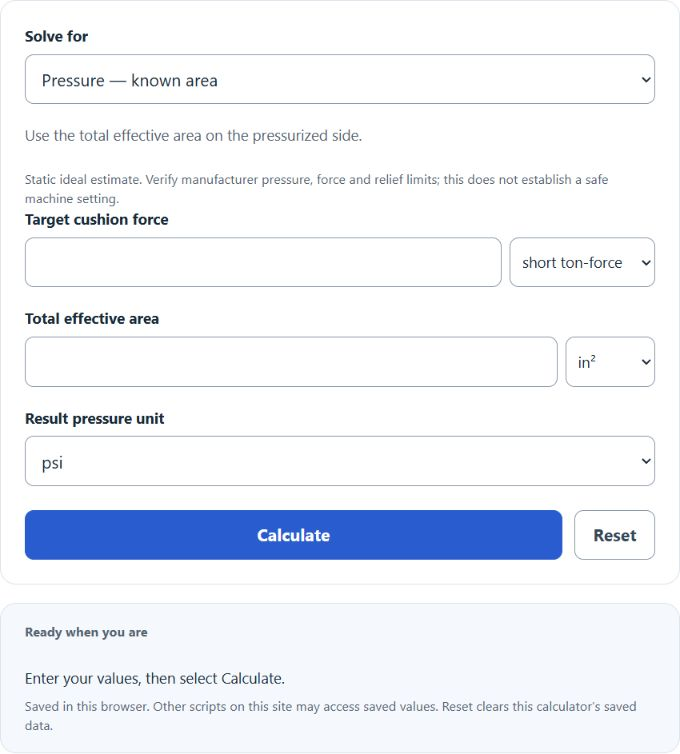
Calculate die cushion pressure or force from cylinder bore, count, and effective area for hydraulic presses in psi, bar, MPa, or kPa.
- Concrete Pressure Calculator
- Injection Molding Cooling Time Calculator
- Die Per Wafer Calculator
- All Construction Calculators
- Extrusion Force Calculator
Die Cushion Pressure Formula
The calculator uses the basic relationship between force, pressure, and effective piston area. The mode you pick changes which variable is solved.
Known area mode solves for pressure directly:
Cylinder bore mode builds the area from the bore diameter and cylinder count:
Force check mode solves for the force a given pressure produces:
- P — cushion pressure (psi, bar, MPa, kPa)
- F — total cushion force (lb, short tons, kN, metric tons)
- A — total effective piston area on the pressurized side
- n — number of cushion cylinders sharing the load
- D — cylinder bore diameter
The formula assumes all cylinders are the same bore, share the load equally, and act on the full piston area (rod-side losses on push cylinders are not subtracted). It treats the system as static. Friction, seal drag, and acceleration spikes during snap-through are not included, so this estimate does not determine a safe working pressure or replace the manufacturer’s ratings and relief requirements.
Reference Tables
Pressure-unit conversions (rounded). Actual allowable cushion pressure is equipment-specific; consult the manufacturer.
| Pressure unit | Equivalent to 1 psi |
|---|---|
| psi | 1 |
| bar | 0.0689476 |
| MPa | 0.00689476 |
| kPa | 6.89476 |
Effective piston area for common cylinder bores. Multiply by the number of cylinders to get total area.
| Bore | Area (in²) | Force at 1,000 psi |
|---|---|---|
| 3 in | 7.07 | 7,069 lb |
| 4 in | 12.57 | 12,566 lb |
| 5 in | 19.63 | 19,635 lb |
| 6 in | 28.27 | 28,274 lb |
| 8 in | 50.27 | 50,265 lb |
Worked Example
You need 40 short tons of cushion force from four 5-inch bore cylinders.
- Convert force: 40 × 2,000 = 80,000 lb.
- Area per cylinder: π × 5² / 4 = 19.63 in².
- Total area: 4 × 19.63 = 78.54 in².
- Pressure: 80,000 / 78.54 = 1,019 psi (about 70 bar).
The ideal result is about 1,019 psi (70.2 bar). It does not confirm safe sizing or a permissible setting. Compare it with manufacturer ratings and operating limits before selecting equipment or a working pressure.
FAQ
Should I use the bore area or the annular area? Use the area on the pressurized side. For most die cushions the load is carried on the full piston, so bore area is correct. If the rod side is pressurized, subtract the rod area.
Why is my calculated pressure higher than the press rating? The ideal pressure needed for the entered target exceeds that rating. Do not use that setting; reassess the target and effective area with the manufacturer or a qualified engineer.
Does this account for snap-through? No. Reverse-load spikes at breakthrough can briefly exceed steady cushion pressure. Size relief valves and accumulators for that transient separately.