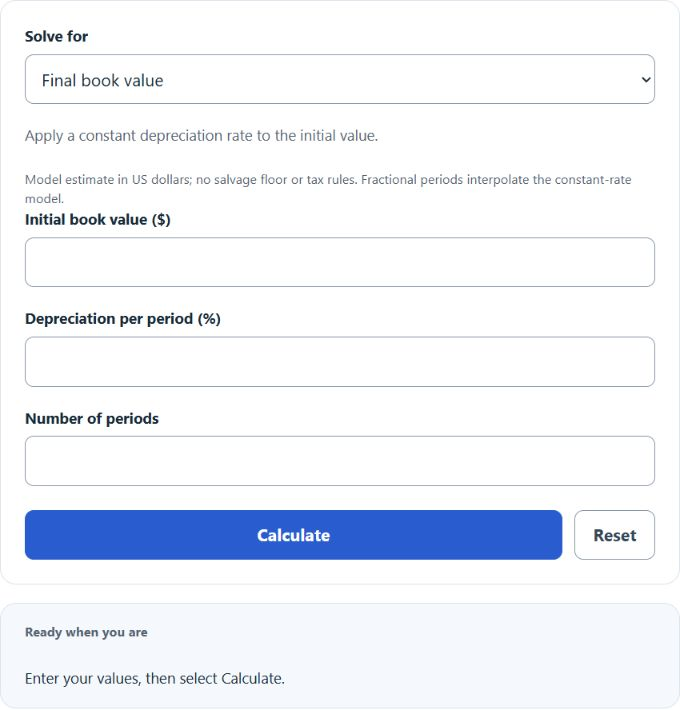
Calculate diminishing balance depreciation by solving for final book value, initial value, depreciation rate, or periods from the other inputs.
Related Calculators
- Residual Value Calculator
- Reversion Value Calculator
- Capitalization of Earnings Method Calculator
- Lease Discount Rate Calculator
- All Business Calculators
Diminishing Balance Method Formula
The following equation is used to calculate the Diminishing Balance Method.
- Where BV(n) is the new book value ($) after period n
- BV(n-1) is the prior period’s book value ($)
- r is the depreciation rate (decimal)
To calculate the diminishing balance, multiply the prior period’s book value by (1 – depreciation rate).
What is a Diminishing Balance Method?
Definition:
The diminishing balance method, also known as the reducing balance method, is a way of calculating depreciation using a fixed rate applied to an asset’s reducing book value each accounting period. This results in higher depreciation expenses early in the asset’s life, which gradually decrease over time.
How to Calculate Diminishing Balance Method?
Example Problem:
The following example outlines the steps and information needed to calculate the Diminishing Balance Method.
First, determine the initial book value. In this example, the asset’s initial book value is $5,000.
Next, determine the depreciation rate. In this example, the rate is 10% (0.10).
Finally, calculate the new book value after one period using the formula above:
BV(1) = 5000 * (1 – 0.10)
BV(1) = $4,500
Thus, after the first period, the book value is $4,500 using the diminishing balance method of depreciation.
FAQ
What is the difference between the diminishing balance method and the straight-line method of depreciation?
The straight-line method spreads depreciation evenly across the asset’s useful life, whereas the diminishing balance method applies a higher depreciation in the early years. This can better reflect an asset’s decline in value if it’s more productive or loses value faster initially.
Can the diminishing balance method eventually fully depreciate an asset?
A positive book value under a constant rate below 100% approaches zero but never reaches it in a finite number of periods. This calculator has no salvage-value floor; actual accounting or tax rules may stop at residual value or switch methods.
Which types of assets benefit most from the diminishing balance method?
Assets that lose value quickly or are more productive in their early years (such as technological equipment) often benefit most from the diminishing balance method as it reflects usage and value loss more accurately during the initial period.