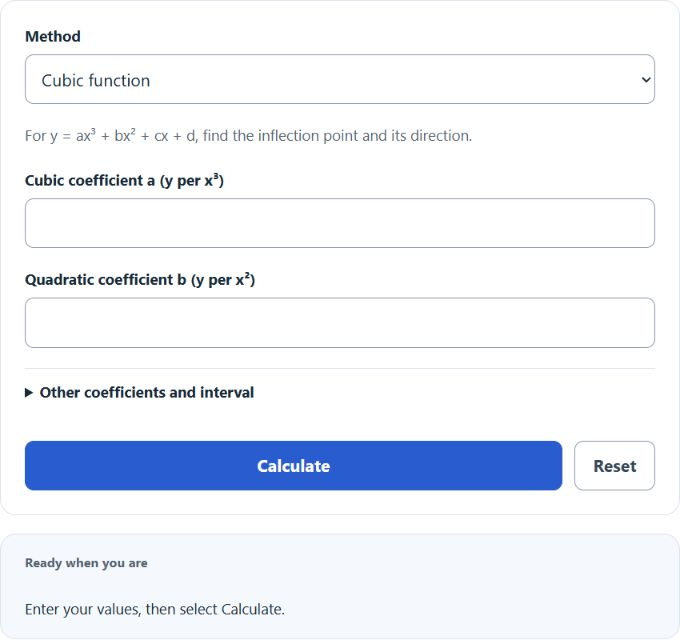
Analyze a cubic inflection point, compare observed interval marginal returns, or calculate unique-outcome probability and an explicitly defined odds metric.
Related Calculators
- Marginal Benefit Calculator
- Marginal Cost Calculator
- Hours Per Part Calculator
- Usage Rate Calculator
- All Business Calculators
Diminishing Returns Formula
The following formula gives interval marginal output from the change in total output and the change in input. Compare successive intervals to identify declining marginal output.
Variables:
- MO is the marginal output
- (Delta TO) is the change in total output
- (Delta I) is the change in input
To calculate the marginal output, divide the change in total output by the change in input. The data-series method compares this quantity across adjacent observed intervals; it requires at least three complete x,y observations.
What is Diminishing Returns?
Diminishing returns, also known as the law of diminishing marginal returns, is an economic principle that describes the decrease in the incremental output of a production process as the amount of a single factor of production is incrementally increased, while other factors remain constant. In simpler terms, it means that adding more of one input (e.g., labor or capital) to a fixed amount of other inputs will eventually yield lower per-unit returns. This concept is crucial in understanding the efficiency and productivity of production processes and is widely used in economics and business decision-making.
How to Calculate Diminishing Returns?
The following steps outline how to calculate diminishing returns.
- First, determine the change in total output ((Delta TO)).
- Next, determine the change in input ((Delta I)).
- Finally, calculate interval marginal output using MO = ΔTO / ΔI and compare it with the preceding interval.
- In the cubic method, a negative cubic coefficient marks a change from increasing to decreasing marginal return; a positive coefficient marks the opposite change.
- After inserting the values and calculating the result, check your answer with the calculator above.
Example Problem :
Use the following variables as an example problem to test your knowledge.
Change in total output ((Delta TO)) = 50 units
Change in input ((Delta I)) = 10 units. This interval has marginal output 50 / 10 = 5 output units per input unit. Another interval is needed to determine whether marginal output declines. The probability method covers distinct outcomes in one equally likely draw: its probability gain per additional outcome is constant, while its reciprocal-odds metric changes at a decreasing rate.