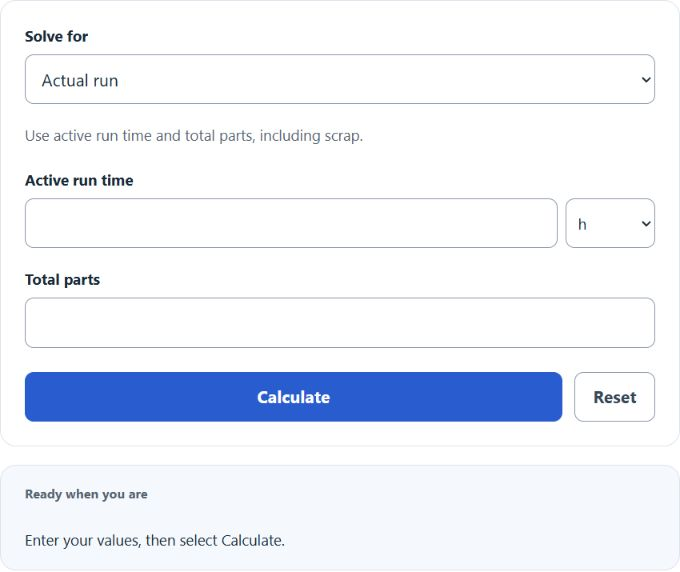
Calculate hours per part, minutes per part, parts per hour, and production time needed from run time, parts produced, or target output.
Related Calculators
- Labor Productivity Calculator
- Billable Hours Calculator
- Service Price Calculator
- Production Increase Calculator
- All Business Calculators
Hours Per Part Formula
The calculator uses these related formulas for actual run measurement, cycle-time or rate conversion, and production planning.
Actual run mode:
Convert mode (rate and cycle time are reciprocals):
Plan mode:
- HPP = hours per part (cycle time in hours)
- T = production run time, in hours
- N = number of parts produced
- R = production rate in parts per hour
Actual run divides active run time by parts, including small slowdowns inside the run. Conversion restates a known rate or cycle time in common units. Planning estimates required run time or theoretical output at a constant cycle time, and shows whole completed parts rounded down. Changeover, breaks and downtime are excluded.
Illustrative Cycle Times and Quick Conversions
The first table contains illustrative ranges, not validated process benchmarks; actual cycle time depends on the part, equipment and routing. The second table shows rounded unit conversions.
| Process type | Illustrative hours per part | Equivalent rate |
|---|---|---|
| High-speed stamping | 0.0001 to 0.001 | 1,000 to 10,000 / hr |
| Injection molding (small part) | 0.003 to 0.017 | 59 to 333 / hr |
| CNC machining (small) | 0.05 to 0.5 | 2 to 20 / hr |
| Manual assembly station | 0.02 to 0.25 | 4 to 50 / hr |
| CNC machining (medium) | 0.5 to 3 | 0.33 to 2 / hr |
| Welded fabrication | 1 to 8 | 0.13 to 1 / hr |
| Industrial 3D printing | 2 to 24 | 0.04 to 0.5 / hr |
| Hours per part | Minutes per part | Seconds per part | Parts per hour |
|---|---|---|---|
| 0.0028 | 0.17 | 10 | 360 |
| 0.0083 | 0.5 | 30 | 120 |
| 0.0167 | 1 | 60 | 60 |
| 0.05 | 3 | 180 | 20 |
| 0.25 | 15 | 900 | 4 |
| 0.5 | 30 | 1,800 | 2 |
| 1 | 60 | 3,600 | 1 |
| 4 | 240 | 14,400 | 0.25 |
Worked Examples
Example 1: Actual run. A machining cell ran for 7.5 hours and produced 450 parts (good plus scrap). HPP = 7.5 / 450 = 0.0167 hr/part. That converts to 1 minute per part, or 60 parts per hour.
Example 2: Plan a job. You need 300 parts and the routing lists 0.125 hr/part. Required run time = 0.125 × 300 = 37.5 hours, which is 4.7 eight-hour shifts of pure run time before you add changeover and breaks.
FAQ
Should I include scrap in the part count? Yes when measuring actual cycle time, because every part consumes machine time. Use only good parts when reporting yield-adjusted rates or calculating cost per good part.
Should run time include downtime? No. Use active production run time so the result reflects the cycle. Including downtime gives you a different metric closer to throughput or OEE-adjusted rate.
How does this differ from takt time? Hours per part is your actual or target cycle time. Takt time is available time divided by customer demand. They match only when you produce exactly to demand with no buffer.
Why is parts per hour the reciprocal of hours per part? Rate and cycle time describe the same process from opposite directions. If one part takes 0.25 hours, then in one hour you complete 1 / 0.25 = 4 parts.