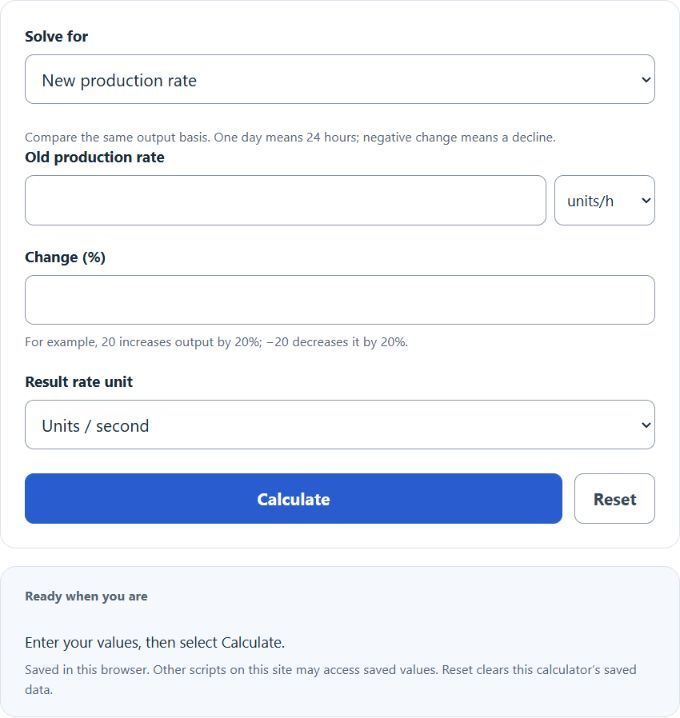
Calculate production increase by entering any two values—old rate, percentage increase, or new rate—to find the missing production rate.
Related Calculators
- Production Rate Calculator
- Production Hours Calculator
- Unit Product Cost Calculator
- Cost Per Hour Calculator
- All Business Calculators
Productivity Formula
The main productivity formula compares billable time to total available time.
Productivity\ \% = \frac{Billable\ Time}{Total\ Time} * 100If you know productivity and total time, the calculator can solve for billable time.
Billable\ Time = \frac{Productivity\ \%}{100} * Total\ TimeIf you know billable time and productivity, the calculator can solve for total time.
Total\ Time = \frac{Billable\ Time}{Productivity\ \% / 100}For clock-in and clock-out entries, total time is based on the net shift time after unpaid breaks.
Net\ Shift\ Time = Clock\ Out - Clock\ In - Unpaid\ Break
Clock\ Productivity\ \% = \frac{Billable\ Time}{Net\ Shift\ Time} * 100For revenue per employee, the calculator divides total revenue by the number of full-time equivalent employees.
Revenue\ Per\ Employee = \frac{Total\ Company\ Revenue}{Number\ of\ Employees}- Billable Time: Time spent on work that counts toward productive or billable output.
- Total Time: Total available work time. In the clock modes, this is the shift length after subtracting unpaid break time.
- Productivity %: Billable time as a percentage of total time.
- Clock In: The time the shift starts.
- Clock Out: The time the shift ends. If clock-out is earlier than clock-in, the calculator treats it as an overnight shift.
- Unpaid Break: Break time removed from the shift total.
- Total Company Revenue: Revenue for the period you are measuring.
- Number of Employees: Employee count measured as FTE, or full-time equivalent employees.
The Billable / Total mode lets you enter any 2 values from billable time, total time, and productivity. The missing value is calculated from the same productivity relationship.
The Clock Time mode calculates net shift time from clock-in, clock-out, and break minutes. It then compares billable time to that net shift time.
The Billable + Shift mode also uses clock-in, clock-out, and break minutes, but it displays total hours worked before calculating productivity from total billable hours.
The Rev / Emp mode is a separate efficiency metric. It does not calculate time productivity. It shows revenue generated per employee.
Common Productivity Ranges
| Productivity result | Meaning | Example in an 8-hour shift |
|---|---|---|
| 50% | Half of total time is billable | 4 billable hours out of 8 hours |
| 75% | Three quarters of total time is billable | 6 billable hours out of 8 hours |
| 100% | Billable time equals total time | 8 billable hours out of 8 hours |
| Over 100% | Billable time is greater than total time | 9 billable hours out of 8 hours |
Time Conversion Reference
| Hours | Minutes | Decimal hours |
|---|---|---|
| 15 minutes | 15 | 0.25 h |
| 30 minutes | 30 | 0.50 h |
| 45 minutes | 45 | 0.75 h |
| 1 hour | 60 | 1.00 h |
Productivity Examples
Example 1: Calculate productivity from billable and total time
You have 5.5 billable hours and 8 total hours.
Productivity\ \% = \frac{5.5}{8} * 100 = 68.75\%The productivity result is 68.75%.
Example 2: Calculate productivity from a shift
You clock in at 8:00, clock out at 16:30, take a 30-minute unpaid break, and record 6 billable hours.
The shift length is 8.5 hours. After the 30-minute break, net shift time is 8 hours.
Productivity\ \% = \frac{6}{8} * 100 = 75\%The productivity result is 75%.
Productivity Calculator FAQ
What counts as billable time?
Billable time is the time that counts toward measured output. This may be client work, patient time, project work, production time, or another tracked activity. Use the definition your workplace or report uses, since productivity depends on what is included.
Can productivity be over 100%?
Yes. A result over 100% means billable time is greater than total time. This can happen if billable credit is not the same as clock time, if work is billed in units, or if multiple billable activities are credited within the same time period.
Should breaks be included in total time?
Unpaid breaks should usually be subtracted from total time. Paid breaks may be included or excluded depending on the policy you are following. In the clock modes, the calculator subtracts the unpaid break minutes you enter before calculating productivity.