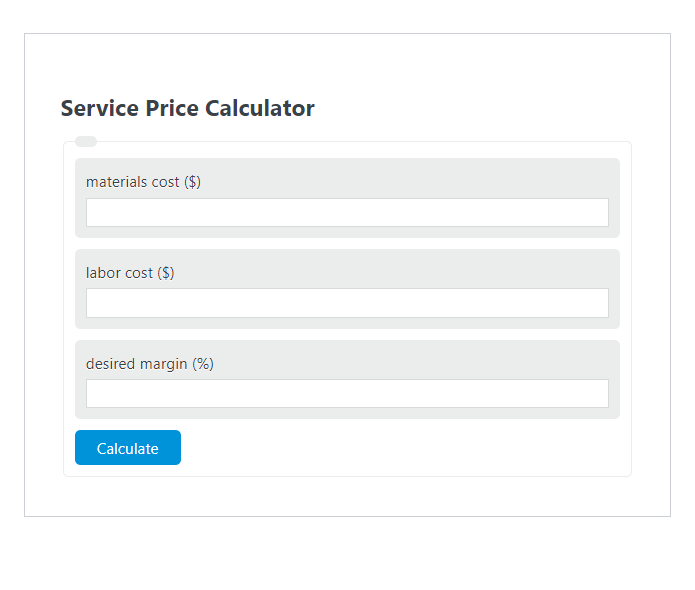
Calculate a profitable service quote from labor, materials, overhead, fees, and target margin, or analyze the margin and markup of an existing customer price.
- All Business Calculators
- All Price Calculators
- Job Price Calculator
- Job Cost Calculator
- Service Charge Calculator
Service Price Formula
The calculator uses three formulas depending on the mode you choose.
Quick costs mode (margin target):
If you set a markup target instead: Price = Cost x (1 + Markup). If you set a flat profit target: Price = Cost + Profit.
Build from hours mode:
Check a price mode:
- Price: what you charge the customer.
- Labor: wages plus payroll tax, insurance, and benefits for the time on the job.
- Materials: parts and supplies consumed.
- Overhead: rent, vehicles, software, advertising, and other fixed costs allocated to the job.
- Margin: profit as a percent of price.
- Markup: profit as a percent of cost.
- Workers, Hours, Rate: crew size, time on site, and loaded hourly cost per worker.
- BillableHours: hours per month you actually invoice, used to spread monthly overhead across jobs.
Quick costs is fastest when you already know the totals. Build from hours turns crew time and monthly overhead into a job price. Check a price tells you the margin and markup on a quote you have already written.
Typical Margins and Markups
Use these ranges as a starting point. Adjust for your local market, risk, and demand.
| Service type | Typical margin | Equivalent markup |
|---|---|---|
| HVAC | 25–35% | 33–54% |
| Plumbing | 30–40% | 43–67% |
| Electrical | 25–35% | 33–54% |
| Landscaping | 20–30% | 25–43% |
| Cleaning | 20–35% | 25–54% |
| Pest control | 25–35% | 33–54% |
| Handyman | 20–30% | 25–43% |
Margin and markup are not the same number. Convert with this table:
| Margin | Markup | Multiply cost by |
|---|---|---|
| 15% | 17.6% | 1.18 |
| 20% | 25% | 1.25 |
| 25% | 33.3% | 1.33 |
| 30% | 42.9% | 1.43 |
| 35% | 53.8% | 1.54 |
| 40% | 66.7% | 1.67 |
| 50% | 100% | 2.00 |
Examples and Common Questions
Example 1: Quick costs. A plumbing job has $250 in labor, $120 in materials, and $80 of allocated overhead. Total cost is $450. With a 30% margin target, price is $450 / (1 – 0.30) = $642.86. Profit is $192.86.
Example 2: Build from hours. Two workers spend 4 hours at a loaded rate of $35/hr. Labor is 2 x 4 x $35 = $280. Materials are $150. Monthly overhead of $4,000 spread over 120 billable hours adds $33.33/hr, or $133.33 for 4 hours. Total cost is $563.33. At a 25% margin, price is $563.33 / 0.75 = $751.11.
Should I price by margin or markup?
Margin is easier to compare against revenue and industry benchmarks. Markup is easier to apply at the counter when you only know cost. Pick one and stay consistent so you do not confuse a 30% markup with a 30% margin.
What is a loaded labor rate?
It is the wage plus everything you pay on top of it: payroll taxes, workers comp, liability insurance, paid time off, and benefits. The loaded rate is usually 25 to 40 percent higher than the base wage.
How do I set billable hours per month?
Start with worked hours per worker per month, then subtract drive time, estimating, callbacks, and downtime. Most field workers bill 60 to 75 percent of their paid hours.
Why is my price higher than competitors?
Either your costs are higher, your overhead is spread across fewer billable hours, or your margin target is more aggressive. Use Check a price on a competitor quote to see what margin they would need to hit your cost structure.