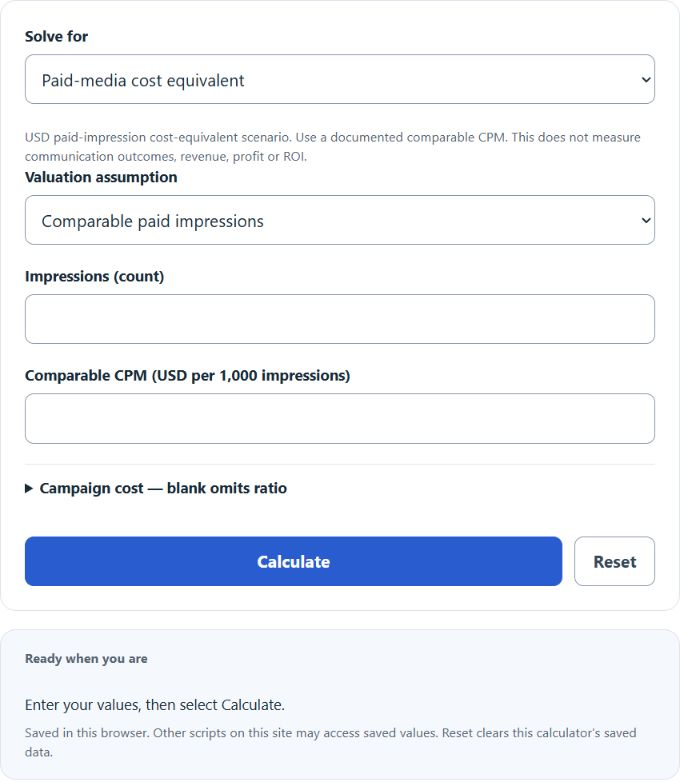
Model a USD paid-impression cost equivalent from a comparable CPM, optionally apply an explicit percentage adjustment, or solve for impressions and CPM. This is a scenario, not communication value or ROI.
- All Business Calculators
- Engagement Rate Calculator
- Website/Ad Conversion Rate Calculator
- Gross to Net Media Advertising Calculator
Earned Media Value Formula
The basic paid-impression cost equivalent is V = I × CPM / 1000. A separately chosen adjustment model additionally multiplies by R / 100. CPM is a cost per 1,000 impressions; use a comparable documented rate and consistent impression definition.
- V (or EMV in the examples) = assumed paid-media cost equivalent
- I = impressions, including repeat impressions; unique reach is a different measure
- CPM = cost per 1,000 impressions for the vertical or channel
- R = explicitly chosen reporting adjustment percentage, used only in adjusted mode
Choose the solve target and valuation assumption explicitly. Complete visible required inputs. Required impressions are rounded upward to a whole count; inverse solves require positive divisors. A blank or zero campaign cost omits the optional equivalent-to-cost ratio.
- Calculate equivalent: enter impressions and comparable CPM; adjusted mode also requires the chosen percentage.
- Calculate impressions: enter EMV, CPM, and rate to find the reach needed to produce that value.
- Calculate CPM: enter EMV, impressions, and rate to find the implied CPM.
- The ±20% CPM sensitivity scenarios are assumptions, not market benchmarks or confidence intervals. The equivalent divided by campaign cost is not ROI.
Illustrative CPM Scenarios and Rate Inputs
Use a documented CPM that matches your campaign measurement, platform, audience and period. The table lists hypothetical arithmetic scenarios only; these are not observed market rates or recommendations.
| Hypothetical scenario | Assumed CPM | Notes |
|---|---|---|
| Scenario A | $2 | Chosen arithmetic assumption only. |
| Scenario B | $5 | Chosen arithmetic assumption only. |
| Scenario C | $10 | Chosen arithmetic assumption only. |
| Scenario D | $25 | Chosen arithmetic assumption only. |
| Rate input | What it can represent | Example |
|---|---|---|
| Engagement rate | Percent of reached users who liked, clicked, shared, commented, or otherwise engaged. | 3 means 3% engagement. |
| Click-through rate | Percent of impressions that produced clicks. | 1.5 means 1.5% CTR. |
| Conversion rate | Percent of users who completed a desired action. | 0.8 means 0.8% conversion. |
Example Calculations
Example 1: Calculate earned media value
In the explicitly adjusted scenario, use 500,000 impressions, a hypothetical $12 CPM, and a chosen 4% adjustment. Basic mode without adjustment would give $6,000.
The adjusted paid-media cost equivalent is $240, not measured revenue or communication value.
Example 2: Calculate the required impressions
You want an earned media value of $1,000, using a $20 CPM and a 5% engagement or conversion rate.
You would need 1,000,000 impressions.
FAQ
What is earned media value?
This calculator models a hypothetical paid-impression cost equivalent. AMEC measurement principles reject advertising-value equivalents as measures of communication value; evaluate actual outcomes and impact separately.
Should I use impressions or reach?
Use impressions with a comparable impression-based CPM. Reach counts unique people and should not silently replace repeated impressions; use a separately justified measurement basis for reach.
Why does the calculator use a rate in the formula?
The percentage adjustment is optional as a modeling choice and is used only when explicitly selected. It is not a universal earned-media valuation rule, and multiplying by a rate does not establish causal business value.