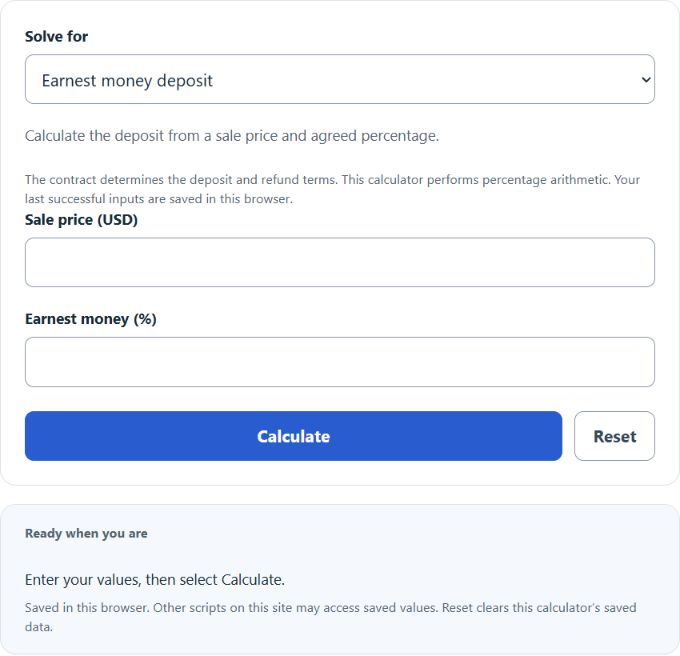
Calculate earnest money deposit, percentage, or sale price by choosing the value to solve and entering the other two in a real estate transaction with formula steps shown.
Earnest Money Formula
The earnest money deposit is calculated as a percentage of the home sale price.
- EMD = earnest money deposit in dollars
- SP = sale price in dollars
- EMP = earnest money percentage
If you know the earnest money deposit and the earnest money percentage, you can solve for the sale price:
If you know the earnest money deposit and the sale price, you can solve for the earnest money percentage:
Choose the value to solve. The calculator uses these formulas with the other two inputs: sale price, earnest money percentage, and earnest money deposit. For example, if you enter the sale price and percentage, it calculates the dollar deposit. If you enter the deposit and sale price, it calculates the percentage. If you enter the deposit and percentage, it calculates the sale price implied by those numbers.
Common Earnest Money Percentages
Earnest money is often shown as a percentage of the purchase price. The exact amount depends on the local market, the contract, and the strength of the offer.
| Earnest Money % | What It Often Indicates |
|---|---|
| 1% | A common lower-end deposit in many residential purchases. |
| 2% to 3% | A typical range for a stronger offer in many markets. |
| 5% or more | May be used in competitive markets or higher-risk contract terms. |
Earnest Money Deposit Examples by Sale Price
| Sale Price | 1% Deposit | 2% Deposit | 3% Deposit |
|---|---|---|---|
| $250,000 | $2,500 | $5,000 | $7,500 |
| $400,000 | $4,000 | $8,000 | $12,000 |
| $600,000 | $6,000 | $12,000 | $18,000 |
Examples
Example 1: Calculate the earnest money deposit
You are buying a home for $350,000 and the earnest money amount is 2%.
The earnest money deposit is $7,000.
Example 2: Calculate the earnest money percentage
The sale price is $500,000 and the earnest money deposit is $15,000.
The earnest money amount is 3% of the sale price.
FAQs
What is earnest money?
Earnest money is a deposit a buyer makes after a seller accepts an offer on a property. It shows the buyer is serious about completing the purchase. The money is usually held in escrow and may be applied toward the buyer's closing costs or down payment at closing.
Is earnest money refundable?
Earnest money may be refundable if the buyer cancels for a reason allowed by the purchase contract, such as a valid inspection, financing, or appraisal contingency. If the buyer cancels without a permitted reason, the seller may be able to keep the deposit. The exact rules depend on the contract terms and applicable law. See the CFPB earnest money definition and NAR escrow and earnest money guide.
How much earnest money should you offer?
The percentages above are illustrations, not a required or recommended range. Deposit amounts vary by market and contract; the parties may also agree on a fixed dollar amount. A larger deposit can make an offer look stronger, but it also increases the amount at risk if you breach the contract.