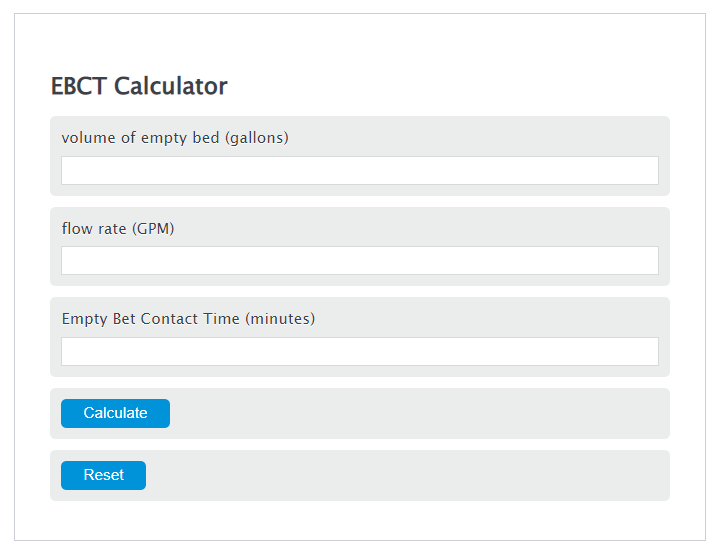
Calculate empty bed contact time, reverse-solve flow or media volume, use direct volume or cylindrical bed dimensions, and see bed volumes per hour.
Related Calculators
- Normalized Permeate Flow Calculator
- SDI (Silt Density Index) Calculator
- Diffusion Rate Calculator
- Acid Demand Calculator
- All Chemistry Calculators
EBCT Formula
Empty bed contact time, or EBCT, is the time water or another fluid would spend in a filter or adsorption bed if the bed were empty. It is calculated from the empty bed volume and the flow rate through the bed.
- EBCT = empty bed contact time
- V = volume of the empty bed
- Q = flow rate through the bed
To calculate the empty bed volume instead, rearrange the same formula:
To calculate flow rate instead, use:
The calculator lets you enter any two of the three values and solves for the missing one. Internally, it converts the inputs to base units of gallons, gallons per minute, and minutes, performs the calculation, then converts the result back to the unit selected for the missing field.
- Calculate EBCT: enter bed volume and flow rate.
- Calculate volume: enter flow rate and desired EBCT.
- Calculate flow rate: enter bed volume and EBCT.
Common EBCT Unit Conversions
Use these conversions to check that your volume, flow rate, and time units are consistent.
| Measurement | Unit | Equivalent in Calculator Base Units |
|---|---|---|
| Volume | 1 liter | 0.264172 gallons |
| Volume | 1 cubic meter | 264.172 gallons |
| Flow rate | 1 liter per minute | 0.264172 gallons per minute |
| Flow rate | 1 cubic meter per hour | 4.40288 gallons per minute |
| Time | 1 second | 0.0166667 minutes |
| Time | 1 hour | 60 minutes |
Typical EBCT Ranges for Water Treatment
| Application | Typical EBCT Range | Notes |
|---|---|---|
| Granular activated carbon, taste and odor | 5 to 10 minutes | Often used for general adsorption performance checks. |
| Granular activated carbon, organic contaminants | 10 to 20 minutes or more | Higher contact time is often needed for harder-to-remove compounds. |
| Ion exchange vessels | 1 to 5 minutes | Actual design depends on resin type and target ion. |
| Small cartridge filters | Less than 1 to several minutes | Short EBCT is common when the media volume is small. |
EBCT Calculation Examples
Example 1: Calculate EBCT
You have an empty bed volume of 120 gallons and a flow rate of 8 gallons per minute.
The empty bed contact time is 15 minutes.
Example 2: Calculate Required Bed Volume
You want an EBCT of 10 minutes at a flow rate of 25 gallons per minute.
The required empty bed volume is 250 gallons.
FAQ
What does EBCT mean?
EBCT means empty bed contact time. It estimates how long fluid remains in contact with the media bed based on the total empty bed volume and the flow rate. It does not account for the space occupied by the media itself, which is why it is called “empty bed” contact time.
Does a higher EBCT mean better treatment?
Usually, a higher EBCT gives the fluid more time to contact the media, which can improve adsorption, ion exchange, or other treatment performance. However, the correct EBCT depends on the media, contaminant, water chemistry, temperature, and treatment goal. A longer EBCT also usually requires a larger vessel or a lower flow rate.
Why must the values be greater than zero?
EBCT calculations require positive volume, flow rate, and time values. A zero or negative flow rate cannot represent normal operation, and dividing by zero is not mathematically valid. If the calculator rejects a value, check that the two entered fields are positive numbers.